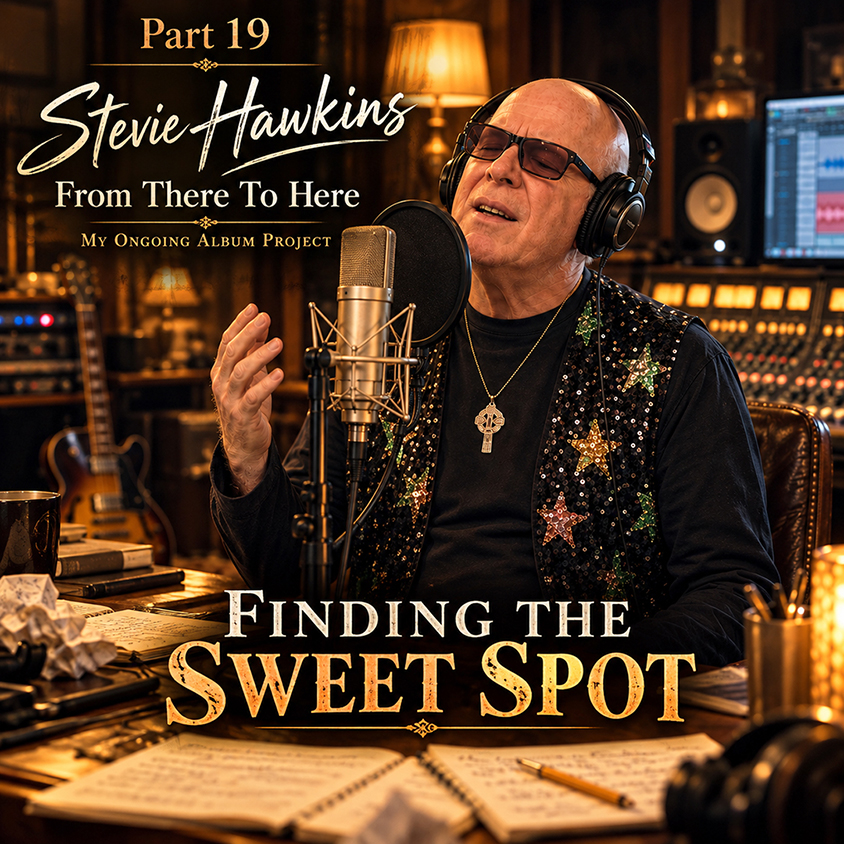
Every album project has a story. "From There To Here" is no exception.
This articles page is dedicated to the fans, passion, creative people and process that will bring this Stevie Hawkins project to life. While the songs will tell one part of the journey, these articles will explore things happening behind the scenes—from the songwriting to the finished recordings, observations, milestones along the way, and other aspects of the project.
Throughout this series, you'll meet the talented musicians whose performances will shape the music, the producers and engineers who will help capture its sound, the mastering engineer who will give the album its final polish, and the marketing team that will work to share the project with listeners around the world
You'll also find updates on the songwriting and recording process, news about the album's release, and information about the crowdfunding campaign that will help make this independent project possible. Whether you're a longtime supporter or discovering From There To Here for the first time, these articles are intended to offer a front-row seat to the collaboration, creativity, challenges, and dedication that will transform an idea into a finished album.
Thank you for joining this journey from the very beginning. Your interest, encouragement, and support mean more than words can express. We invite you to follow along as we document each step and celebrate the people whose talents and commitment will help take From There To Here from an idea to a completed album.
Hey everyone, I thought I'd share an update on the new album project. After about a month of my songwriting flow paused preparing for my concert at the Capitol Theatre week before last, I'm happy to say I'm finding my way back into the creative groove and moving steadily toward the finish line. The songs are continuing to come together, and I'm genuinely excited about what's emerging both lyrically and melodically. Every time I sit down to write, the universe seems to guide me to where it needs to go. There's something special happening with this record, and each new song seems to open another creative door.
As the writing has evolved, so has the vision for the album. What initially started leaning toward a blues record has grown into something much broader musically. The sounds, textures, and arrangements I’m hearing in my head have led me to a big decision: most of this album will now be recorded in Nashville. It's likely that I will record my final vocals in Atlanta, GA, as well as any necessary instrument overdubs.
One of the most important decisions in making a record is choosing the people who will help bring the songs to life. Technical skill and professional credentials certainly matter, but great records are built on something deeper—chemistry, instinct, shared vision, and the ability to serve the music. The right producer understands not only how a song should sound but also how to help uncover its full potential. Likewise, the right musicians bring more than their instruments to a session; they bring experience, feel, creativity, spontaneity, and the ability to elevate a performance in ways that can't always be written on a chart.
The most inspiring aspect about the gathering of the team for this album is the mix of talent, instinct, and musical intuition. They are players who know how to listen as much as they play, can hear where a song wants to go, and provide immediate, instinctual performances, adding embellishments that take a good track into the realm of something special. The musicians for the project are specialists in blues, blues-rock, Southern rock, and American roots music, accustomed to playing on major recording sessions and on the big stages, which is exactly what and who I want for this project: authenticity. Equally important was having a co-producer who understood that musical language and could help me shape and guide the performances, bringing an experienced ear and a shared vision that tied the entire project together.
As the songs develop, I feel certain that I've put together the right creative team for beginning the journey ahead. The level of trust, experience, and artistry that they all bring to this album will be integral in making it as great a record as I think it can be. Bit by bit, I'll be slowly lifting the veil and revealing each of the people who are a part of making this album happen—the co-producer, musicians, recording studios, engineering staff, and more.
And with that said, I'm excited to begin revealing the remarkable people who have joined me on this project.
Let's start with the first reveal.
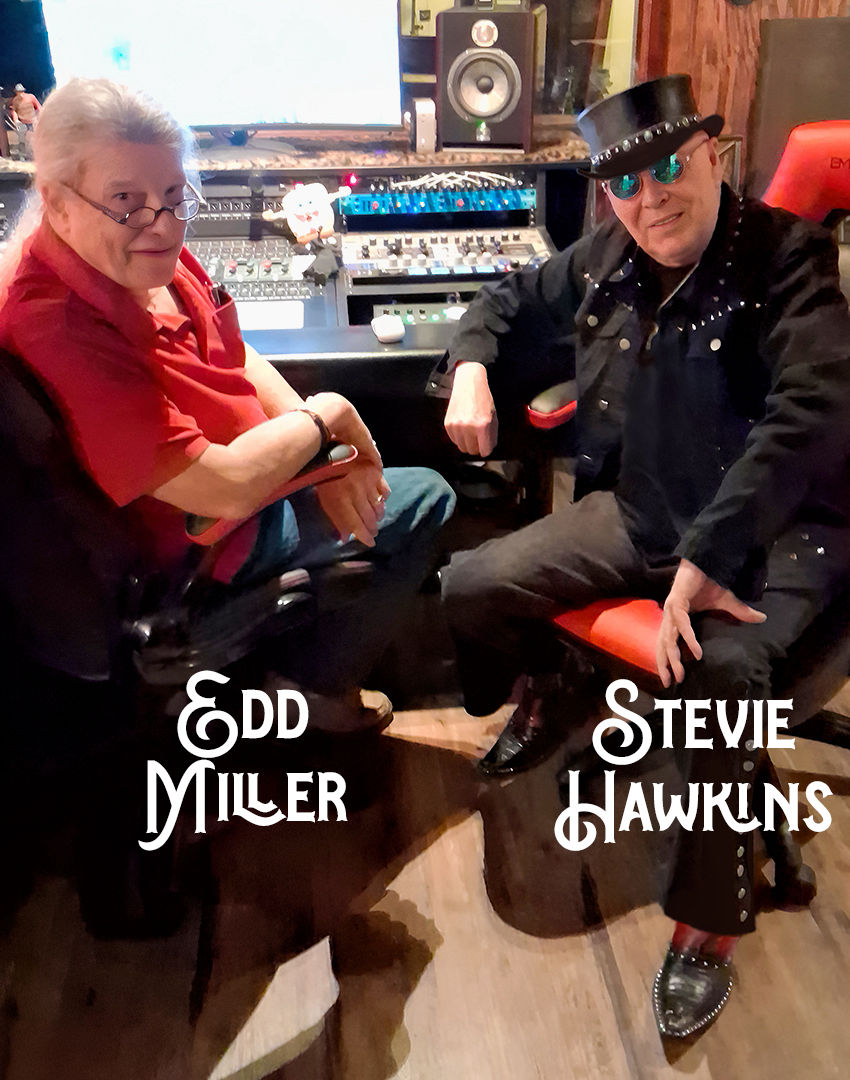
I am sincerely delighted and honored to have an incredible co-producer on this new album project, Edd Miller. (Yes, spelled with two d's.) I first met Edd back in 2020 at a blues gig where I was playing drums and singing at the end of COVID. What started as a random meeting through music began to slowly develop into friendship and respect for each other's professional work. And right away from the first conversations we had about the project, it just felt right. We clicked on many levels, and also because we both care deeply about making great music. It was obvious to me that Edd was the creative co-production partner to go on this journey with. He boasts decades of experience, combined with a deep understanding of both the artistic and technical sides of record-making, making him particularly suited for my project as a whole.
What really stands out to me about Edd isn’t just his impressive track record—it's who he is and the energy he brings to every creative moment. He’s genuinely kind, laid-back, and always keeps the big picture in mind: serving the song. Spending time together discussing the project confirmed that we share a common vision, a commitment to excellence, and a desire to make the strongest album possible. Those qualities, combined with his musical instincts, production expertise, and genuine passion for the craft, make him an invaluable creative partner and exactly the kind of person you want helping guide a project.
Edd's impressive body of music production work can be heard on recordings by Willie Nelson, James Brown, .38 Special, Kansas, Drivin' N Cryin', William Bell, Tinsley Ellis, Phunk Junkeez, Jimmy Dawkins, Francine Reed, Randall Bramblett, Theodis Ealey, and many others. Starting his music career as a drummer and percussionist, Edd developed a conscious awareness of musicianship and presentation before his talents turned to the recording console. This foundation guided his collaborative production style, assisting vocalists and musicians in reaching their best possible work in the studio.
That mix of character, background, and skill elevated Edd to among the most respected recording engineers, producers, and mixers in the field.
Edd has also worked with and learned from some of the most influential producers and engineers in the business, such as Paul Rothschild (Janis Joplin, The Doors), Rodney Mills (Gregg Allman, Lynyrd Skynyrd), Bob Ezrin (Alice Cooper, Kiss, Pink Floyd), J.J. French of Twisted Sister, and Howard Benson (Motörhead, Kelly Clarkson). Such an upbringing developed his multi-talented approach to production and technique.
In 1993, Edd joined Ichiban Records as a staff producer and engineer, and his discography soon reflected a diversity that included blues, avant-garde rock, gospel, rhythm & blues, and classic rock & roll. Edd has brought a rare blend of musical insight, technical exactness, and years of professional experience to each project, whether producing an artist's vision, engineering a session, or creating a final mix.
In the late 1990s to the mid-2000s, Edd launched his own recording studio and established CMO Records. This move enabled him to continue expanding his work as an engineer, producer, mixer, and mentor to artists, continuing to build a body of recorded works. With his studio and record label, Edd created a nurturing environment for collaboration and artistic growth, further reinforcing his reputation as a respected figure in the recording industry and a passionate advocate for great music.
The vision for this album continues to grow clearer with every song. While there's still plenty of work ahead, the pieces are falling into place, and I'm more energized than ever about where this journey is leading.
Thank you all for your continued encouragement and support. I can't wait to share more as the project continues to take shape. Remember, "be a realer, a healer, and a peace and love dealer."
- Stevie Hawkins
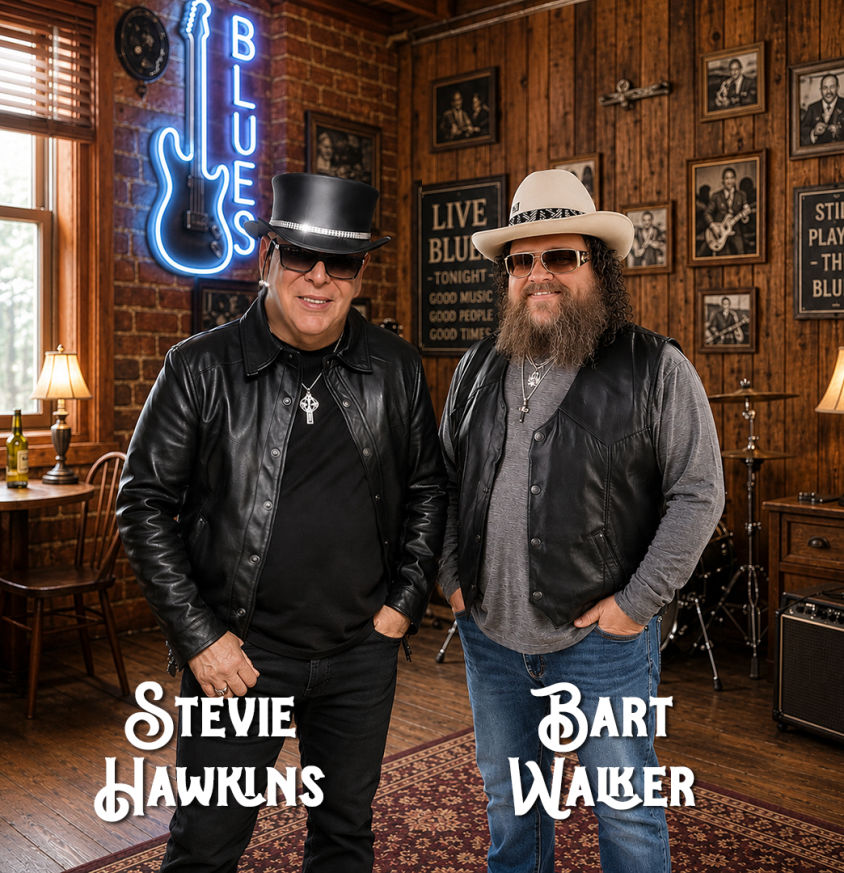
And now for Part 2 of my Nashville album session team announcements, and I’m excited to share that Bart Walker will be joining us as a featured guitarist on the project.
I shared the stage with Bart a few years ago at the Daryle Singletary "Keepin' It Country" Jam. There were some outstanding guitarists on that stage, but Bart immediately caught my attention. His playing was soulful, confident, and effortless—the kind of guitarist who makes you stop and listen. On top of all his talent, Bart is just a great hang—laid-back, kind, and genuinely friendly. He brings a smile and a relaxed, positive energy to any room he walks into. It's no surprise that he's earned a reputation as one of the most respected and genuine musicians in Nashville.
Today, Bart tours and records with both Hank Williams Jr. and Jamey Johnson, and those are not gigs that go to just anyone. Both artists are known for surrounding themselves with musicians who bring authenticity, passion, and world-class talent to the stage every night.
What excites me most isn't his résumé. It's the way he plays. Bart has deep roots in blues and Southern rock music, and he combines technical skill with something that can't be taught—feel. Other musicians love working with Bart because he serves the song, not his ego. There's honesty in his playing; his solos tell a story, and that's exactly what I want and need on this record—honesty and storytelling. I have no room for egocentric ramblings of technical prowess that don’t serve the song.
Bart plays custom guitars built for him by Lucky Dog Guitars in Cleveland, Tennessee. If you've heard Bart's unmistakable tone on stage or in the studio, there's a good chance one of these handcrafted instruments was part of the equation. Their quality and character make them a perfect match for a player who values feel, expression, and serving the song above all else.
Many fans recognize Bart as one of Nashville's top blues-rock guitarists, but ask musicians and guitar players in the know, and you'll often hear the same thing: Bart Walker is one of Nashville's hidden gems. Over the years, his guitar has taken him around the globe, sharing stages throughout the U.S., Europe, Australia, and the U.K. with artists such as T. Graham Brown, Buddy Guy, Derek Trucks, Warren Haynes, Kenny Wayne Shepherd, Robert Randolph, Delbert McClinton, Lee Roy Parnell, Steve Cropper, B.B. King, Lynyrd Skynyrd, Styx, and REO Speedwagon.
His studio credits include work with Dolly Parton, Mike Farris, Bo Bice, Royal Southern Brotherhood, A.J. Croce, Steve Gorman, Texas Hill, and many others.
Among his many accomplishments, he won the Gibson Best Guitarist Award at the International Blues Challenge in Memphis. He later released the acclaimed album Waiting on Daylight, produced by legendary producer Jim Gaines.
Bart is also passionate about giving back, mentoring guitarists from around the world through Bart's Badass Guitar School and hosting guitar camps at his farm just outside Nashville. If you'd like to learn more, visit https://www.badassguitarschool.com.
When thinking about assembling a small team of next-level musicians based in Nashville, I knew I wanted specialists in blues, blues-rock, and Southern rock—players who truly understand the feel, authenticity, and storytelling that these songs demand. I'm fortunate that two of those musicians are old friends of mine, and Bart was an easy choice for the team. I am honored to have him on board and can't wait for all of us to hear what he brings to these songs.
And yes... I'll be revealing that second guitarist soon!
- Stevie Hawkins
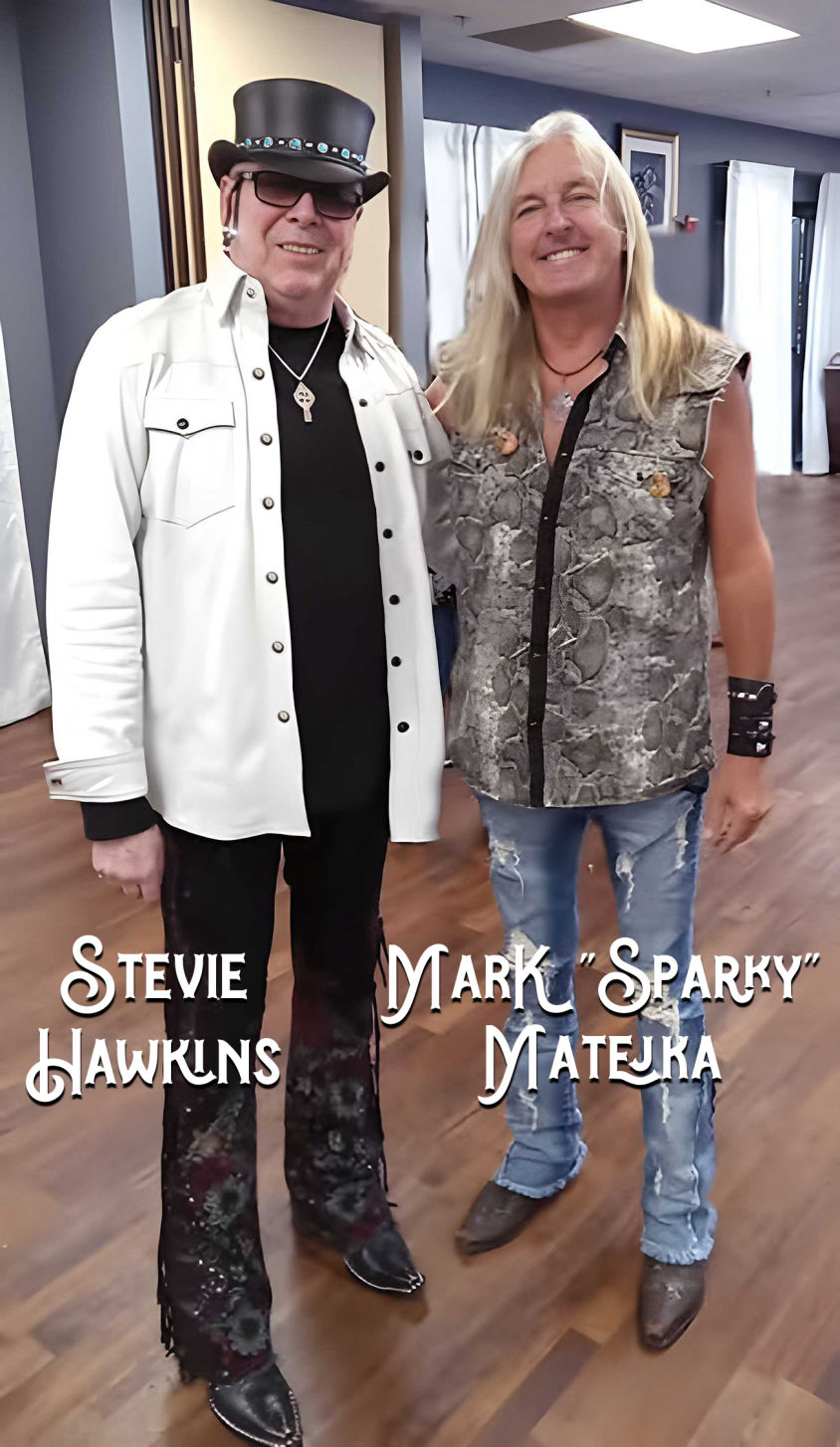
Part 3 of the Stevie Hawkins Nashville album sessions: team announcements. I couldn’t be more fired up to share that “Sparky” Mark Matejka—my friend of over 20 years and guitarist for Lynyrd Skynyrd—is bringing his creative fire and guitar command to my songs. Most of us just call him Sparky. To be honest, if I called him Mark, half of his friends would probably wonder who I was talking about!
For my new album recording sessions, Mark brings a refined, modern Southern rock guitar approach, while Bart Walker comes from a deep blues and blues-rock foundation. When I started putting this team together, I knew exactly what I wanted the guitar foundation of this album to be. I wanted the authenticity of blues, blues-rock, and Southern rock, and that meant bringing in energetic musicians who specialize in those styles. Bart and Sparky aren't visiting these genres for a recording session—they've spent their careers living in them. Mark's precision, melody, and modern edge sitting right up against Bart's raw, soulful grit create a push-and-pull contrast that will give these songs a fresh energy and a sound rooted in blues-rock but pushed forward with a strong Southern rock voice running through it. There is a method to my madness, ladies and gents! Contrary to popular belief, I don't just throw darts at a wall when putting a record together—although it would probably be faster.
Sparky and I first met in early 2006 when we played together during a week-long residency at the Ameristar Casino in Kansas City, Missouri. Right away, there was a natural musical chemistry and mutual respect that made that week feel special on and off stage.
At the time, Mark was in the middle of a major transition. After a five-year run playing guitar with The Charlie Daniels Band, he was joining the legendary ranks of Lynyrd Skynyrd—walking straight into one of the most iconic guitar roles in rock.
What many people don't know is that Mark's musical path was a little different from a lot of Southern rock guitarists. Born in Houston, Texas, he learned plenty on stages, in clubs, and on the road, but he also pursued formal training at the University of North Texas. Studying under noted guitar educator Jack Peterson, he focused on jazz improvisation, music theory, and ensemble performance, earning a bachelor's degree cum laude in jazz studies in 1990.
That education gave him a deep understanding of harmony, improvisation, dynamics, and arrangement, but what has always impressed me is that you never hear the education getting in the way. Instead, it enhances everything he does. Sparky can move seamlessly from blues to country, from hard-driving Southern rock to sophisticated melodic improvisation, all while sounding completely natural. In other words, he knows enough music theory to make the rest of us nervous, but he's got too much good taste to show off about it.
As it turned out, whenever Sparky was off the road with Skynyrd, our paths kept crossing. Before long, we found ourselves sharing the stage on various weekends at The Dinner Bell in Cookeville, Tennessee—a former roadhouse-style nightclub owned by my good friend Kevin Poe. Alongside country artist Ronnie Swift and a weekly rotating cast of Nashville touring and session players, we spent many nights making music, swapping stories, solving absolutely none of the world's problems, and having a great time doing it!
Anyone who's shared a stage with Sparky knows what he brings. Beyond his playing, he has the ability to elevate everyone around him. His feel, musicality, and instincts are top-shelf, and his constant stream of ideas keeps every performance fresh. You never know exactly what he'll do next—but it always works. Whether it's the perfect fill, a blistering solo, or subtle textures that reshape a song, Sparky brings music to life. Every now and then he'll play something that makes the rest of us look over and think, "Well, I sure didn't see that coming."
This time, we're not playing someone else's music—we're bringing my songs to life. Having a player of Mark's caliber contribute his talent and musicality to these recordings is a real gift. I know what he brings to a performance, and I'm genuinely excited to hear how Sparky's guitar sits alongside Bart Walker's on these tracks. I have a feeling they're going to push each other in all the right ways, and I can't wait for all of us to hear the results. If I have anything to say about it, we're going to have a whole lot of fun getting there, too.
Back soon with Part 4 of the Stevie Hawkins “From There To Here” album sessions!
Revealed thus far are, co-producer Edd Miller, guitarist Bart Walker, and guitarist Mark "Sparky" Matejka.
- Stevie Hawkins
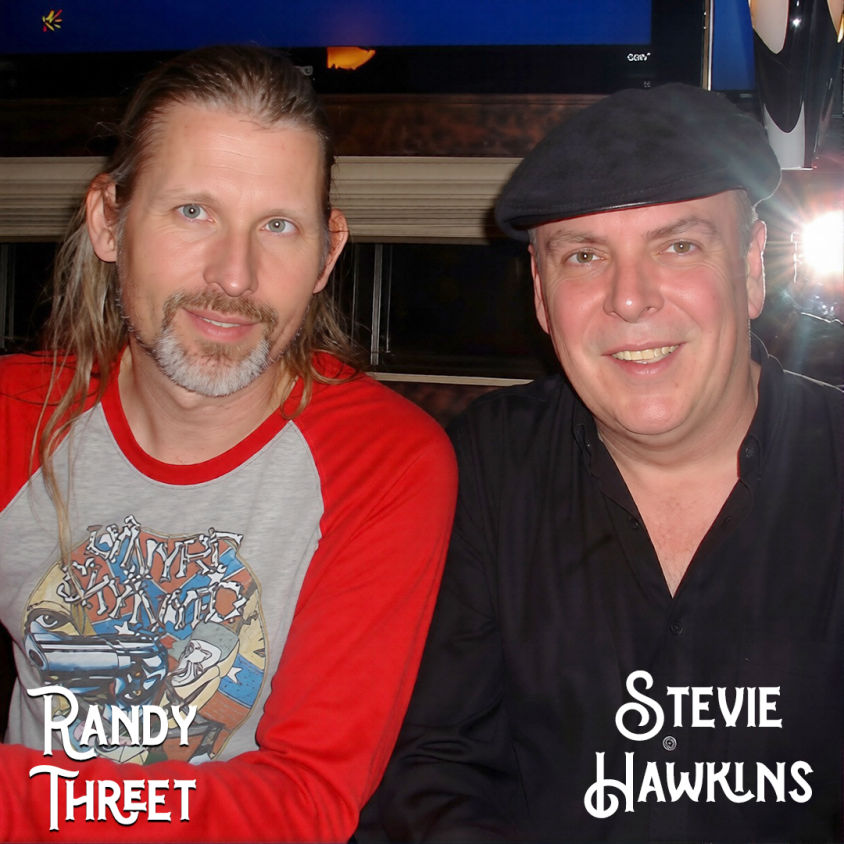
Part 4 of my Nashville album session team announcements. If there’s one thing I needed for these sessions, it was a rhythm section built on players who don’t just know the language of blues, blues-rock, and Southern rock—they are the language. Joining me on bass for several tracks is my old friend Randy Threet.
Randy sits in a rare space in American music. Most people know him as an exceptional bassist, but what really sets him apart is that he also carries the vocal weight of two of the most harmony-driven bands in the genre—Blackhawk and The Outlaws. That combination—deep-pocket groove on the low end and elite tenor harmony vocals above it—is what makes him one of the most complete support musicians working today. He doesn’t just hold down the rhythm section. He helps define the sound of the entire band from the bottom up.
I’ve known Randy for 19 years, and long before these recording sessions were ever planned, I knew that if the right songs called for it, he was somebody I’d want in the room.
When I started assembling the team for this album, authenticity was everything. I wasn’t trying to “build a band” in the traditional sense—I was building a musical system. Bart Walker brings deep blues and blues-rock grounding. Mark “Sparky” Matejka brings modern Southern rock authority. Randy brings the low-end foundation and structure that ties those worlds together. Put simply, this isn’t three players occupying space—it’s three specialists working the same musical ground, where groove, melody, and harmony come from lived-in experience rather than formulas or guesswork.
Years ago, Randy and I first played together in the band of the late, great Daryle Singletary, whose hits include “Too Much Fun,” “I Let Her Lie,” and “Amen Kind of Love.” That’s where I really got to know him—not just as a musician, but as a person you want in the room every night on the road.
And if you’ve ever spent time on a tour bus, you already know: that matters just as much as the playing.
Randy also happens to have the best Billy Bob Thornton “Carl from Sling Blade” impression I’ve ever heard. Back in those Daryle Singletary days, that alone probably kept a few long drives from feeling twice as long as they were.
But none of that would matter if the musicianship wasn’t real—and Randy’s reputation is exactly why he’s been trusted for decades in two very different musical worlds.
For more than twenty years, he’s been a cornerstone of both Blackhawk and The Outlaws, bringing the versatility, consistency, and musical instincts that have made him one of Nashville’s most respected working musicians. Whether the music calls for country precision, Southern rock grit, or deep blues-influenced groove, Randy has spent his career proving he can move seamlessly between them. That’s exactly the kind of musician I wanted on this record.
On bass, he plays exactly how great Southern rock and blues bass players should play: no excess, no spotlight chasing—just time, tone, and feel. His groove is smooth, powerful, and unshakably steady. Playing with him feels like everything locks into place without effort.
And then there’s his voice.
Randy is one of the most reliable high harmony singers I’ve ever worked with. The ability to sing demanding tenor parts while locking in a bass performance at that level is rare enough. Doing it consistently for decades across two major touring bands is something else entirely. His harmonies don’t sit on top of the music—they complete it.
What I’ve always respected most is that Randy never plays for attention. Everything he does is about the song and the people he’s playing with. That mindset is exactly why he’s been able to sustain such a long career at a high level across multiple major acts.
He’s performed and recorded with artists including Trisha Yearwood, Pam Tillis, Larry Boone, Buddy Jewell, Daryle Singletary, Blackhawk, The Outlaws, and many others, and has shared stages with members of Lynyrd Skynyrd, The Marshall Tucker Band, and The Allman Brothers Band.
But credits only tell part of the story.
The real story is consistency—decades of showing up, being focused, locking in, singing the hard parts, holding down the foundation, and making everyone around him sound better while doing it.
That’s why I wanted him on this record.
Because when you combine Bart’s blues foundation, Sparky’s Southern rock edge, and Randy’s musical system of rhythm and harmony, you don’t get a stylistic experiment—you get something that was always meant to exist. Nothing is decorative. Everything has a job. And when it locks in, it feels like it was always meant to be that way.
And I can’t wait for people to hear what that sounds like when it’s all in the same room.
- Stevie Hawkins
Part 5 of the "From There To Here" album project... We've spent the last few updates getting to know the incredible musicians and co-producer who'll be helping bring this record to life. I thought we'd step away from the creative team for a moment and talk a little about the songs themselves—and the journey that's been shaping them from the very beginning.
For the past few months, I've been living in a pretty solitary songwriting world—and I expect to stay there until it naturally feels like it's time to move into the recording sessions. I'm not trying to rush the process or force songs onto the page. I've learned over the years that songs have a way of showing up when they're ready, not necessarily when it's convenient. My job is simply to be there when they arrive.
Some of you have probably noticed the phrase "From There To Here" appearing alongside this project. That's more than just an album title. It's really become the thread connecting almost everything I've been writing.
This record reaches back to childhood and follows the road all the way to where I stand today. The people who shaped me, the places I've been, the victories, the disappointments, the lessons, the music, the friendships, the love, the losses, and all the unexpected turns in between—they've all found their way into these songs in one form or another.
Writing this album has been a little like flipping through old photo albums. Every song seems to bring back another memory, another face, another chapter I hadn't thought about in years.
I suppose you could call it soul-searching. Maybe even a bit of emotional housekeeping. Whatever it is, it's been one of the most honest writing experiences I've ever had. There are a few songs that still catch me off guard. I'll be halfway through singing one and suddenly remember exactly where it came from. Every now and then I have to stop, collect myself, and start over. That's usually a pretty good sign that I'm writing about something that matters.
I've started down the road of writing more 'radio-friendly' songs a couple of times, and by design there are a few songs that step outside the album's core concept, but I keep finding myself pulled back toward something deeper.
That doesn't mean it's a heavy album.
Quite the opposite.
There's plenty of energy here, plenty of optimism, and more than a few moments where the volume knob gets turned to the right. At its heart, though, these songs are about perspective, resilience, gratitude, believing in yourself when life gives you reasons not to, and finding light even after walking through some darker places. If someone hears one of these songs and finds a little piece of their own story inside it, then I'll feel like I've done my job.
Musically, the album has surprised me, too.
When I first began planning this project, I thought I was making a traditional blues record. The blues is still very much the heartbeat of what I'm writing, but somewhere along the way the songs started asking for something bigger. What has emerged feels more like contemporary blues with a healthy dose of blues-rock and Southern rock woven into the fabric. Some songs breathe quietly, while others dig in with a little more attitude. It all feels remarkably natural—as though the record has quietly been telling me what it wanted to become all along.
As the writing starts to wind down, my thoughts are naturally beginning to shift toward the recording sessions. I've got a Nashville studio in mind that I believe would be a terrific fit for this project—a room with the sound, character, and atmosphere to capture these songs the way I hear them in my head. Nothing is set in stone just yet, and I don't want to make that final decision until the writing is complete. I want the songs to tell me exactly what they need before we roll the first take. After spending months living with these songs on paper and in my head, it'll be a pretty special moment to finally hear them come to life with this incredible group of musicians.
So that's where things stand.
Still writing. Still listening. Still discovering where these songs want to go. And enjoying every step of the journey.
Thank you all for following along and for the encouragement you've shown throughout this process. It means more than you know.
- Stevie Hawkins
Part 6 of the "From There To Here" album project... Although the recording sessions for my *From There To Here* album project are still a few months away, I've already been thinking a great deal about what I want those sessions to feel like and how best to communicate that vision to my co-producer and the musicians who will help bring it to life. I am nearing the completion of writing the songs, and as that process continues, my thoughts are naturally turning toward how these stories, emotions, and experiences will come alive in the studio.
The music and vocal melodies are taking shape. The songs are finding their voices. Now I am thinking about capturing not just the notes, but the spirit behind them.
As a vocalist, I know my vocal lane well. I understand where my voice naturally belongs, where the emotional arcs are, and where they should be to best serve each song. At the same time, I remain open to thoughtful guidance and suggestions from those with the experience and credentials to help me continue developing as a vocalist. Ultimately, I know my voice, my instincts, and the emotional connection I want to create with each song better than anyone, while still appreciating the value an experienced perspective can bring.
My approach to singing has been shaped by a significant shift in how I write and create music. I don't believe I truly found my own voice as a vocalist and songwriter until I stopped writing primarily from a commercial perspective—where vocals often needed to follow a strict, predictable, or more repetitive melodic structure. Stepping away from that mindset allowed me to focus more on interpretation, emotion, and telling the story within the lyrics.
Over the past 30 years, my approach has not been one of simply repeating a vocal melody for a verse or bridge exactly the same way every time. Instead, I approach each performance as an opportunity for interpretation—exploring what I'm feeling in the moment and what I'm hearing from the musicians around me, and allowing the emotion of the song to guide how I deliver each phrase, each word, and even the subtle character of a single vowel sound.
That said, a chorus often serves a different purpose. I'll usually keep its melody and cadence consistent when doing so strengthens the song's emotional connection and gives listeners something familiar to hold onto. For me, singing is a creative process of painting a vocal picture of the lyrics, allowing the emotion of the song to shape each phrase naturally.
Something has shaped me as a musician for decades, and it will be an important part of how I want to approach these recordings.
It's easy to believe that the best recordings come from carefully planned performances where every turn and every note is mapped out before the red recording light comes on. I've learned something different.
Most of the greatest musical moments I've ever experienced weren't planned at all. They just happened. Those are the moments I still live for as a musician and vocalist.
For years, I've been fortunate to play in bars, tour with bands, and perform at concerts, festivals, and university fraternity and sorority events, experiences that have allowed me to share the stage with remarkable musicians who helped shape the way I think about making music. I've also had the privilege of performing alongside blues and rock legends—musicians whose recordings helped define an era. Some were connected to Capricorn Records, the legendary label that introduced the Allman Brothers to the world.
What those experiences taught me goes far beyond technique. They taught me that some of the most powerful moments in music are the ones that can't be planned. They happen when musicians are listening as closely as they're playing—when one player offers an idea, another responds, and suddenly the music becomes a conversation. That is when musicians stop simply performing a song and begin creating something that exists only in that particular moment.
For a musician, there is no substitute for experiencing that kind of connection. It teaches you to trust your instincts, to leave room for discovery, and to understand that sometimes the most meaningful note is the one you didn't know you were going to play until the moment arrived.
You can actually feel it when an entire band lands in that place together. The musicians begin listening more than they're thinking. The music develops a personality of its own, wanders down an unexpected road for a time, then somehow finds its way home again. When it happens, everyone on stage knows it. More importantly, the audience knows it too. I've seen the reactions time and time again, especially among younger audiences.
But that kind of musical freedom only happens when every player is fully connected and capable of responding in the moment. Every musician has to be in sync with the others, much like the cylinders of a finely tuned engine working together to create something greater than any one part could produce alone. Each player has a role, but the real power comes from how those individual parts communicate and work together.
If one element isn't there—if one player can't hear, react, or rise to the moment—the music can't truly transform. It can't take on a new personality and follow that unexpected road. But when every musician is locked in, something special happens. The music begins to breathe, ideas are exchanged in real time, and the song can travel somewhere nobody planned for it to go.
That is one of the reasons bands like the Allman Brothers, the Grateful Dead, Gov't Mule, Widespread Panic, and so many others built such loyal followings. Their audiences weren't only drawn to the songs themselves; they were drawn to the moments that happened within those songs—the extended conversations, the unexpected turns, and the spontaneous musical passages that could never be recreated exactly the same way twice. They trusted the musicians. They trusted the moment. They left room for discovery.
That is also one of the reasons Bart, Sparky, and Randy are such a perfect fit for this project. They are not only exceptional musicians; they are a group that understands how to listen, respond in the moment, and move together as one. They trust each other's instincts, they leave room for discovery, and they have the ability to follow the music wherever it wants to go while always finding their way back home.
That's the spirit I want to bring into these recording sessions. Yes, I want the tracks to be tight. Yes, I want every song to tell its story. But at the same time I want the music to be loose and "breathe."
When listeners eventually hear my album From There To Here, I want them to hear more than songs. I want them to hear four musicians listening to one another... Taking chances... Smiling when something unexpected happens... Having fun... And enjoying the journey together.
Because sometimes the most memorable moments in music are the ones nobody saw coming.
- Stevie Hawkins
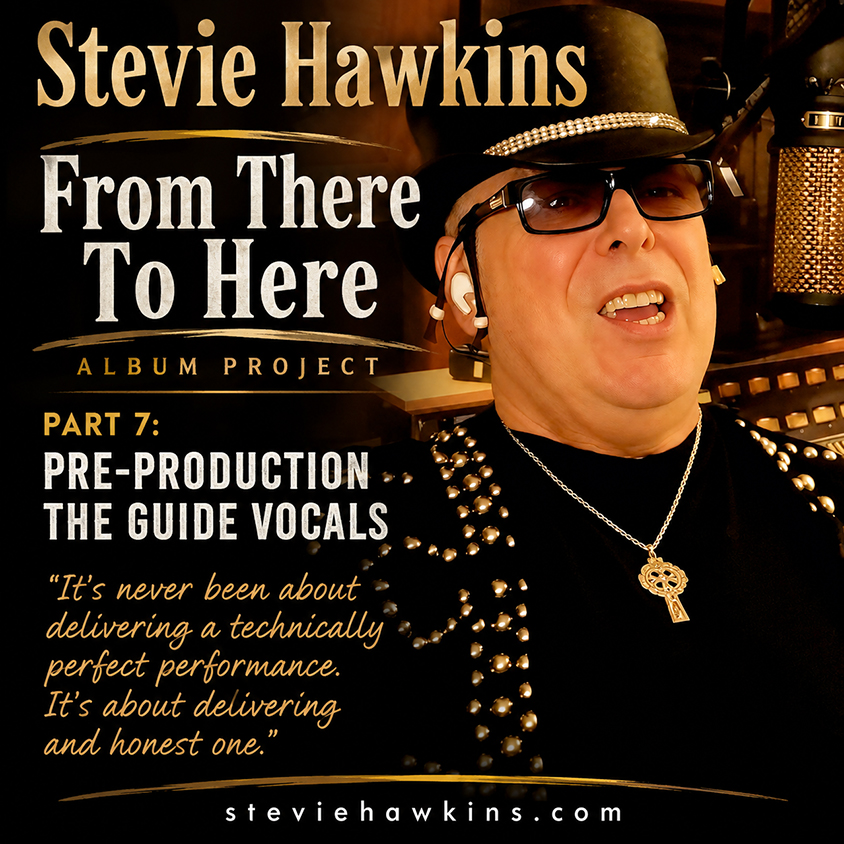
Part 7 of the "From There To Here" album project... With the music demos almost finished and the lyrics for From There To Here nearing completion, I'm about to start hearing these songs the way they'll eventually be sung. The next step is recording my guide vocals—a stage that quietly shapes almost everything that follows.
These aren't final vocals. In many ways, they're working blueprints.
The purpose of these recordings is threefold. First, they help me learn and internalize each song before stepping into the studio. Second, they provide my co-producer a structural and emotional blueprint. Third, they give the musicians a clear roadmap as they begin developing their own parts for the master recording sessions.
These tracks become the first musical conversation between me, the co-producer, and the other musicians involved in the album. They give all of us a shared musical starting point, providing a sense of the melody, phrasing, and emotional direction while still leaving room for each player to bring their own creativity into the final recordings.
Although I've been writing and rewriting these songs for several months, these sessions are often the first time I actually sing them from beginning to end.
While writing the lyrics, I have always had a basic melody in my head for each song. The way this project has unfolded, I intentionally chose to continue writing one lyric after another instead of stopping to record guide vocals along the way.
I felt that constantly shifting between writing and recording would interrupt the creative wave that has continued to flow throughout this project. For me, it was more important to stay in that creative space and allow the songs to keep coming.
Now it's time to give those melodies a voice.
The Recording Setup:
People are often surprised to learn that I record guide vocals at home using a very simple setup. I've never believed that good recordings require the newest gear. In fact, I tend to gravitate toward older equipment because, to my ears, it simply sounds better. These ears have spent a lifetime listening not only to music, but also to the details behind it—the tones, textures, performances, and production choices that make a recording feel alive.
Looking back, I've realized I've been listening to music this way since I was about eight years old. While most people naturally connected with the song itself, I found myself wondering why a vocal sounded the way it did, how an instrument achieved a particular tone, why certain sounds were placed where they were in the mix, or why a song was arranged the way it was. I didn't know it at the time, but I was already listening like a producer and recording engineer.
I use an Avid Mbox Pro 8x8 audio interface as the digital hub for recording my vocals. Designed by Avid's Pro Tools | HD hardware team, it features professional-grade microphone preamps, 24-bit/192 kHz audio resolution, flexible I/O routing, and a dedicated hardware monitor control section. Even though it is no longer the newest piece of equipment on the market, it continues to deliver exactly what I need.
I record and edit my vocals with Avid Pro Tools 10.3.10 HD, an older version of one of the music industry's most widely used digital audio recording programs. I've been using Pro Tools for more than 20 years, and it has continually proven to be a reliable part of my recording process. Since it still does everything I need, I've never felt the need to replace it simply because a newer version exists.
Depending on the personality of the song, I'll choose from several different microphones. Each one has its own character, and sometimes changing microphones is enough to inspire a completely different vocal approach.
People sometimes ask if I have a favorite microphone. The truth is, every microphone has its own personality. Choosing one isn't about finding the "best" microphone—it's about finding the one that best serves the song.
Over the years, I've learned that there really isn't one microphone that works perfectly for every voice, instrument, or style of music. While many producers and engineers have their go-to microphones—often classic choices like the Neumann U47, U67, or U87—and those microphones have earned their legendary reputations, I've always believed the right microphone depends on the source and the song.
I learned that lesson in the 1970s while watching and working around legendary producers and recording engineers such as Bob Ezrin, Ed Sprigg, Corky Stasiak, and Jim Frank at Record Plant East Studio in New York City. What stood out to me was that they didn't limit themselves to only the most expensive or celebrated microphones. They used whatever best captured the sound they were looking for. The microphone locker at the Record Plant Studio contained about 250 microphones, everything from inexpensive to high-end Neumann, Telefunken, and AKG condensers and RCA ribbon microphones.
One example that has always stayed with me was watching engineer Ed Sprigg choose a Radio Shack Realistic Highball 2 microphone to capture Dick Wagner's guitar amp speaker cabinet during an Alice Cooper recording session produced by Bob Ezrin at Record Plant East. Seeing a top-level engineer make that choice in a major studio environment made a lasting impression on me. It reinforced the idea that the value of a microphone isn't determined by its price tag or reputation but by whether it captures the character and emotion the recording needs. I eventually bought one myself, and it remains in my microphone locker to this day because, in the right situation, it still has a character and usefulness all its own.
Seeing and hearing how they chose microphones—not based on price or reputation, but on the character they brought to a performance—was an invaluable part of my education. That approach has stayed with me ever since and continues to influence the way I make recording decisions today.
When I’ve chosen the microphone that best fits my voice for a song, the signal path itself is intentionally simple. The microphone signal passes through a tube microphone preamp imparting warmth, analog color, and harmonic richness before feeding into my Mbox Pro and then directly into Pro Tools running on my Macbook Pro laptop.
Other than using the tube microphone preamp, one thing I don't do is record using compression or EQ. I prefer to capture my vocals completely natural and unprocessed, preserving the performance exactly as it comes through the microphone. If any equalization, compression, or other processing is needed, I'll apply it later after the vocal has been recorded and committed to its own track. I prefer making those decisions during playback rather than while I'm concentrating on delivering the performance.
Interestingly enough, this is essentially the same recording chain I've used on nearly every vocal performance you've heard on my recordings over the years. Simple, familiar, and dependable
Finding the Vocal Performance:
The goal during these sessions isn't perfection. It's exploration.
This is where the songs really begin to take on a personality. I experiment with vocal melodies, phrasing, dynamics, emotion, breathing, and even silence. I'll try different ways of approaching a line, emphasizing certain words, softening others, stretching a vowel just a little longer, or changing the way I attack a phrase.
Sometimes I'll discover that singing less actually says more. Other times, I'll find that a lyric I loved on paper needs another rewrite once I hear it performed.
These guide vocal sessions also help me discover whether a melody feels natural to sing, whether a lyric flows the way I intended, and whether the emotional arc of the song feels genuine from beginning to end.
After a guide vocal is recorded, I don't immediately move on. I'll live with it for a while—listening in the car, through headphones, or while working around the house.
Oddly enough, I often hear things differently when the music is playing in another room while I'm in the kitchen cooking. Something about the way the frequencies travel from the listening room through the kitchen area changes the perspective. It allows me to hear the relationship between the vocal, instruments, and chord changes in a different way.
Sometimes I'll notice a vocal phrase that needs a little more attention, an instrument part that may need to be adjusted, or a chord progression that could be strengthened. These are things I might not recognize while sitting directly in front of the studio monitor speakers, focused on the technical side of the recording.
Distance has a way of revealing things. Stepping away from the speakers and simply listening as a listener—not as the person who created the song—often reveals what the song truly needs.
The Importance of an Honest Performance:
That philosophy doesn't end once I step into the studio to record the master vocals, either.
While I certainly want every performance to be human and good, I'm not chasing technical perfection. In fact, I'll often leave small imperfections in a final vocal on purpose.
A note that's ever so slightly sharp or flat, an unexpected breath before an important line, or a voice that cracks just enough to reveal genuine emotion can sometimes say more than a perfectly polished take ever could.
For me, great vocals aren't measured by perfection—they're measured by how they make someone feel. I'd rather capture an honest, emotionally compelling performance than a flawless one that sounds sterile. Those little human imperfections are often what listeners connect with because they're real.
Over the years, I've come to realize that's become a defining part of my vocal sound.
"It's never been about delivering a technically perfect performance. It's about delivering an honest one."
If a vocal makes someone stop, listen, and feel something, then it's done exactly what I hoped it would do.
By the time I walk into the studio to record the master vocals, I want the songs to feel completely lived in. I want to know every lyric, every phrase, every breath, and every emotional turn. The technical side of singing should already be second nature so that all my attention can be focused on delivering the performance.
These guide vocals won't be heard outside my studio other than by the project's creative team, and that's perfectly fine. They aren't meant for release. Their job is to prepare me—and everyone else involved—to make the very best record we can.
They're where the songs begin finding their voice...and where I continue finding mine.
For me, this is another step in the journey from there...to here.
- Stevie Hawkins
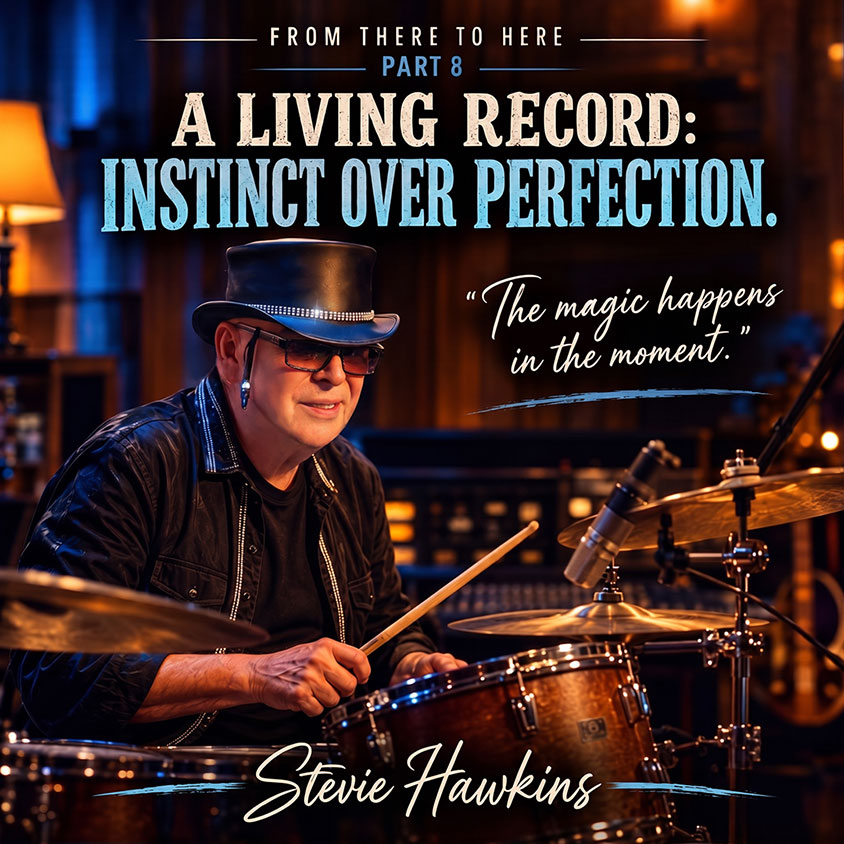
Part 8 of the "From There To Here" album project... As I continue finishing the music demos and prepare to begin recording the guide vocals, I've noticed my thoughts drifting away from microphones, preamps, and recording schedules. Instead, I keep coming back to a much simpler question: What kind of record do I want From There To Here to become?
At first glance, that might not seem like an important distinction. After all, a song is a song... right?
I mean, if it were really that simple, every record would leave the same impression. We would all just need the right microphone, the right guitar, and apparently a lot less time arguing about gear.
Not exactly.
More Than Notes and Performances:
Over the years, I have come to believe that the way a record is made becomes part of what the listener ultimately hears. It is not just the notes, the lyrics, or the performances. It is the spirit in which those performances are captured.
Some records sound polished. Some records sound impressive. And then there are those rare records that simply feel alive. Those are the records that have stayed with me throughout my life. They make you feel like you are sitting in the room with the musicians. The performances breathe. The humanity feels genuine. Every song seems to have a heartbeat of its own.
Those are the records that reminded me why I fell in love with music to begin with.
That is the kind of record I want From There To Here to become. Not because it is technically perfect. Because it feels honest.
I have never believed great records are made by equipment alone. And trust me, I love gear as much as the next musician. I can spend plenty of time talking about microphones, tones, and all the little details that make recording engineers lean in and other people slowly realize they may have accidentally joined a very specific conversation.
But equipment alone has never been what makes a record special. Great records are made by gifted people, in the right environment, trusting one another enough to let the technology fade into the background and simply make music. When that happens, something special begins to take shape. It becomes more than a collection of songs. It becomes a living record.
Chasing The Moment:
Sometimes the most memorable moments in music are not planned. They are found. A subtle change in dynamics. A guitar phrase that was never expected. A drummer responding to the weight of a lyric. A bass line that suddenly finds exactly where it belongs.
Those moments cannot be scheduled, and they cannot always be recreated through endless repetition. That is the funny thing about music. The harder you try to force those moments to happen, the more they seem to hide.
They happen when musicians are listening and reacting to one another instead of simply playing their assigned parts.
Those are the moments I live for.
Controlled Abandon:
Over the years, I have also learned something important about myself as a musician. I do my best work when I am playing from instinct instead of analysis.
For my own original music, I have made one commitment to myself that I carry into every recording session: I will not record more than three drum takes.
That is not because I expect the third take to be the best take. It is because I know where my best performances come from. The first few takes are where I am most connected to the song. I am listening, reacting naturally, and allowing the music to guide me instead of trying to control every note I play.
Then something begins to change.
The fourth take is where things get dangerous. That is where I stop chasing the performance and start chasing ghosts.
I start thinking about what I am playing instead of simply playing it. I begin analyzing choices, questioning decisions, and becoming aware of the mechanics instead of the feeling. That is when the performance starts moving away from instinct. Not because we have run out of ideas, but because I do not want to lose the very thing we are trying to capture: spontaneous energy and emotion.
Maybe other musicians can stay in that creative space longer. I haven't found that to be true for me.
For me, this is what controlled abandon means. It is not playing without discipline or awareness. It is trusting the connection I have with the song, trusting the musicians around me, and allowing the moment itself to guide the performance.
The preparation is understanding the heart of the song deeply enough to allow instinct, creativity, and freedom to take over when the recording begins.
Building The Foundation:
For a project like From There To Here, preparation does not mean creating a traditional band environment where the identity of the music is developed through repeatedly working through songs together before recording.
This record begins with the foundation of the songs—the writing, arrangements, demos, and creative direction behind the music. That foundation is where much of my responsibility as the artist and producer exists, along with Edd Miller, my co-producer.
Together, our role is to establish the direction and create the foundation that allows the musicians involved to bring their best into the recording process.
The People Who Bring the Music to Life:
The musicians I chose for this project bring something that goes beyond technical ability. They have the rare ability to instinctively sense what is about to happen musically. That kind of awareness is not something that can simply be taught. It comes from a natural connection to music, strengthened through years of listening, performing, and developing a deeper understanding of what a song needs.
Deeply musical people understand where the music wants to go. They do not just play the notes. They listen, respond, and contribute to the movement of the song.
That is one of the reasons Bart Walker, Mark “Sparky” Matejka, and Randy Threet are part of this project. Beyond their exceptional musical abilities, they are simply great people. They bring a humility and openness into the room that makes collaboration natural. They are comfortable being themselves, they leave ego behind, and they bring a sense of fun that allows creativity to flow freely.
For me, that matters.
The best sessions are not only about having great musicians. Equally important is having the right people with the right energy in the room.
I want the musicians involved in this project to bring their ideas, creativity, and personalities into these songs. I do not want people simply recreating demos. I want musicians responding to the music and allowing the songs to become something greater through their individual contributions.
The goal is not for everyone to hear the exact same thing. The goal is for everyone to contribute something that helps the song become what it was meant to be. That is where the magic happens.
Lessons From Nashville:
One of the reasons I believe so strongly in this approach comes from sitting in Nashville studios, quietly watching musicians I admired do what they do. I learned far more in those rooms than I ever expected.
The master session musicians I have worked with there have taught me something important: Seasoned musicians do not need endless time to find their place in a song. They have already spent a lifetime developing their craft.
They listen.
They understand.
They contribute.
A typical Nashville tracking session is a great example of this. The musicians gather together and listen to a song demo. They discuss the arrangement, make any agreed-upon adjustments, suggest ideas, and make sure everyone understands the direction.
Then they play.
The engineer records the first take.
And many times, that first take captures something special.
That moment when everything connects—that is the magic.
If there are small adjustments needed, they make them. A band leader may ask for a correction, a "fix," or an overdub where necessary. But the goal is never to endlessly chase a performance.
Once the song has what it needs, they move forward.
There is a confidence that comes from experience. These musicians do not have to overthink every decision because their instincts have been developed through years of playing. They are not searching for the music. They are bringing the music with them.
There is also something freeing about watching musicians who trust their instincts. They do not spend 45 minutes searching for an answer that the song has already given them. They make a decision, they commit, and they play.
Recording with those musicians is inspiring. It is also a little dangerous because it reminds you how much you still have to learn. You leave the session excited, motivated, and briefly considering whether you should practice another six hours a day.
Even after all these years, I still love that moment just before the count-off. Everyone knows the song. Everyone knows why they're there. And for the next few minutes, nobody really knows exactly what's about to happen. That's still one of my favorite places in the world.
Creating The Environment:
That is the environment I want to create for From There To Here.
I am not trying to build a band in the studio. I am bringing together accomplished musicians who already know who they are and giving them the freedom to bring their own voice into these songs. The goal is not for everyone to become something different. The goal is for each musician to contribute who they already are in service of the music. That is how a collection of great musicians becomes something more.
A Living Record:
A great record is a living thing. That is what I want to achieve with From There To Here.
Not a collection of perfect performances, but a record that feels like something alive is happening every time someone presses play.
A record where musicians trusted one another.
A record where emotion was never sacrificed in pursuit of perfection.
A record that captured the moment when preparation gave way to instinct.
A living record.
- Stevie Hawkins
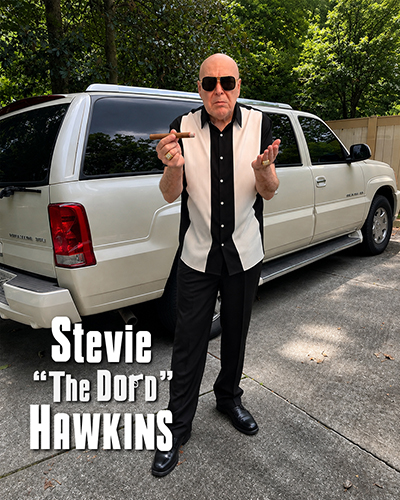
Part 9 of the "From There To Here" album project... So, how did I end up wearing a Sopranos shirt, holding a cigar, wearing diamond rings, and standing alongside a white Cadillac Escalade?
It was all in good fun.
But sometimes life has a strange way of circling back.
What started as a playful photo opportunity unexpectedly connected two very different chapters of my life.
Because this wasn't just any Cadillac.
It was Tony Soprano's white 2003 Cadillac Escalade ESV driven by James Gandolfini during the final two seasons of the HBO series, The Sopranos. Before his passing in 2013, Gandolfini personally autographed several places inside the vehicle, making it a genuine piece of television history.
Today, the Escalade has found its way back in front of the cameras. Actor Pete Davidson brought it to Atlanta, where it's being used during the production of Tommy Karate, a feature film based on the life of Bonanno crime family associate Thomas "Tommy Karate" Pitera.
Through someone Charlotte and I know on the production team made the rare and fun photo opportunity with the Soprano Cadillac possible while it was off set.
What surprised me was what it reminded me of.
The car wasn't just connected to a fictional mob boss. It unexpectedly took me back to a real chapter of my own life—one that became a part of the inspiration behind a song I wrote for my upcoming album project, From There To Here.
What follows isn't the history of a nightclub. It's the true story behind a song I recently wrote as part of my upcoming album project—the people I met, the events I witnessed, and the lessons I carried with me from a remarkable chapter in my life at The Lower Level.
Before I could write the song, I had to live it—and that journey began when I was sixteen years old, behind a drum kit in a place called The Lower Level.
The Lower Level:
The Lower Level sat on Asheville Highway just outside Knoxville, Tennessee. It was a late-night roadhouse where the band didn’t begin until midnight and played until five in the morning.
The room had its own personality. Orange shag carpet covered the walls. Colored flood lights on the stage reflected through the haze of cigarette smoke, and by two o’clock a.m. the dance floor was usually full. Out front, people came to hear the music. In the back, poker and blackjack tables stayed busy, with poker games sometimes continuing on for several days.
But the club itself is not what stayed with me. It was the people.
I had landed a job that placed me among seasoned musicians, business owners, gamblers, law enforcement officers, politicians, and a collective of people whose stories I would not fully understand until decades later.
I thought I was there to play drums, to develop my craft.
I was receiving an education no classroom could have provided but was unaware of that until later on in life. I was learning about music, but I was also learning about people—their personalities, their choices, their struggles, and the experiences that shaped them.
Decades later, those observations found their way into one of the songs on my From There To Here album project.
The Musicians Who Shaped Me
I found my way to the Lower Level through two musicians who would have a lasting influence on my life.
Phil Lord and Les Gray had been performing together for years. Les sang while playing drums, and Phil played guitar and sang while handling bass pedals with his left foot. They were seasoned professionals with far more experience than I could imagine at my young age.
Then everything changed.
Les was seriously injured in a motorcycle accident and spent an extended time in the hospital. Suddenly, Phil needed a drummer and singer.
My mother, who had occasionally worked with Phil and Les as a vocalist, told Phil about me. I auditioned, got the job, and found myself playing alongside musicians who were my mother's age.
When I stop and think about it, that was an extraordinary opportunity.
I wasn't just learning songs. I was learning from professionals who had already spent years on stages, in clubs, and navigating the realities of the music business.
Phil, originally from Boston, often shared stories about playing clubs in the North-east during the late 1960s and early '70s. Some of those venues, he explained, had organized crime connections, and getting paid at the end of the night was never guaranteed. Sometimes you were paid in full. Sometimes only part. Sometimes not at all. The unspoken rule was simple: don't argue with the people in charge.
Those stories fascinated me, but Phil's greatest influence wasn't in the tales he told. It was in the example he set.
He believed that being a musician meant far more than playing the right notes. Professionalism mattered. Presentation mattered. The way you dressed, the way you carried yourself, and the respect you showed your audience were all part of the performance. He constantly challenged me to grow, encouraging me to play and sing material well beyond my years.
Many of the habits that stayed with me throughout my career began with Phil.
When Les recovered and returned, the band became even stronger. Besides being a drummer, he was also a piano player and a good soulful vocalist, but what impressed me most was his ability to understand people.
Les could read a room.
He knew when to speak, when to listen, when to ease tension with humor, and when to simply let a moment pass. Watching him taught me that communication wasn't just about words—it was about timing, awareness, understanding body language and the people around you.
He also gave me something every sixteen-year-old dreams about: my first car.
It was a pea-green 1959 Volkswagen Beetle. It may not have been the prettiest car in Knoxville, but to me it represented freedom. Suddenly, I wasn't depending on someone else to get me to rehearsals or late-night gigs or to the grocery store.
Without a doubt, Phil and Les gave me far more than a job. They helped shape the musician—and ultimately the songwriter—I would become.
People Are Rarely Just One Thing:
The musicians were only part of what made the Lower Level unforgettable. The people who owned it, worked there, and walked through those doors taught me lessons that had nothing to do with music.
I was surrounded by people whose experiences were far beyond my own. I wasn't studying them or trying to understand their histories or reputations. I was simply getting to know people one conversation and one moment at a time.
Only years later did I begin to understand the holistic perspective.
Howard Stormer and Jim "Jimbo" Green were the owners of the Lower Level, and they were two of the most memorable personalities connected to the club.
To others, Howard may have been known as the businessman who owned the property where the Lower Level was located. To me, he was simply Howard.
He loved his Cadillac, enjoyed dressing the part of a high-roller, and had a larger-than-life goofy personality. But the side of Howard I remember most was the person away from the nightclub—the man whose home I visited, where we would shoot pool, tell jokes, have dinner, talk about cars, women, and music, and enjoy ordinary moments.
I didn't know Howard through headlines or history. I knew him as a person.
Through Howard, I occasionally crossed paths with people whose names would later become associated with some of the most talked-about Southern mob figures and stories of that era. A couple of those people were Dixie Mafia, State-Line Mob ringleaders, the charismatic Kirksey Nix Jr, and the fearless, intensely ambitious and ruthless ego-centrist, Carl “Towhead” White.
In 1973, I met Sheriff Buford Pusser. His notoriety as the sheriff of McNairy County, Tennessee, the films, and the compelling events surrounding his life had made him nationally recognized. To many people, he represented a fight against organized crime and corruption along the Tennessee-Mississippi border, including Nix and White's State-Line mob. I remember him showing me the large stick he carried and explaining that he used it instead of a traditional firearm. However, to me, he was simply a person standing in front of me.
At the time, those meetings did not feel historical. They were simply moments. I judged people by how they treated me, the conversations we shared, and the experiences we had together. The broader context came much later.
At this juncture, you discover the indirect but unique connection I made to the Soprano Cadillac, the new Bonnano film, and my past intersecting with those wild and woolly Southern mobster characters and this larger-than-life sheriff who was actively shutting down their illegal operations.
That was one of the most important lessons the Lower Level taught me: people are rarely just one thing.
Jim “Jimbo” Green was the other owner of the Lower Level, but to me, he became much more than a businessman. He was one of the funniest people I ever knew. He always had a joke ready and could turn almost any situation into laughter. He loved entertaining people and would occasionally sit in with the band to sing "Hot Nuts" by Doug Clark & The Hot Nuts, much to the delight of the crowd.
That was Jimbo.
But beneath the humor was something else. He looked out for me. In many ways, he became my protector at the Lower Level. He understood that I was young and that I was stepping into an adult world before I fully understood it. He watched what was happening around me and made sure I was okay. Those actions meant more than I probably realized at the time.
Robert, the bartender, taught me something different.
He worked every night in an environment filled with people from every background imaginable. Some carried kindness. Some carried prejudice. Some carried reputations that could be intimidating.
But Robert had a quiet strength. He was patient. He was respectful. He knew how to connect with people without losing himself. Watching him taught me that every environment has its own language—not just words, but body language, tone, timing, and the ability to understand people.
Then there was Big Jack Amick, a silent financial partner in the Lower Level.
Big Jack was the blackjack dealer, and because there was only one blackjack table, everyone knew him. He was larger than life.
He carried a thick roll of cash folded in half and held together with a rubber band, typically 3 to 5 thousand dollars. Almost every weekend, he would pull it out, peel off a hundred or two hundred dollars, and hand it to me with a grin.
"Stick that in your pocket and don't spend it on licorice sticks."
That was Big Jack: funny, generous, and always putting on a show. He fit right in.
Sisco and Ed were part of that same world.
Sisco dealt poker and always greeted me with, "What's happening, Big Shot Daddy Rabbit!" Ed was quieter, but he had his own unforgettable personality: he was always grinning with his upper and lower teeth showing and clamped together.
Around that same time, all three of them bought a new 1973 Chevrolet Corvette Stingray. Jack's was black. Ed's was orange. Sisco's was white.
One morning after closing, Ed took me for a ride in his Corvette. Asheville Highway had a long, straight stretch of road, and Ed decided to see what the car could do. The speedometer climbed and climbed. I looked down and saw the needle approaching 160 miles per hour. I was terrified. Ed was grinning.
Reflecting, it sounds like something from a movie. But that was simply life around the Lower Level. The cars people drove, the jokes they told, the way they dressed, and the way they carried themselves were all part of their identity.
They weren't just people passing through a nightclub. They were the personalities that gave the Lower Level its character.
The World Beyond The Stage:
The Lower Level had another side that existed beyond the music.
Up front, people came to hear the band, dance, and enjoy the night. But out of sight behind the scenes ran a criminal empire of high-stakes gambling, whispered plots, dirty money, and dangerous men hiding in plain sight.
I was not part of that world. I was a young musician. I was there because I loved playing drums. But being there meant I witnessed things most people my age never saw.
The card rooms were part of the rhythm of the night. While the music continued on the front stage, poker and blackjack games continued in the back. I watched from the perspective of an observer—not as a participant, but as someone taking in everything happening around me.
I watched people celebrate victories and deal with losses. I watched confidence turn into disappointment and excitement turn into frustration.
Those moments taught me lessons that had nothing to do with gambling. They taught me about choices. They taught me about consequences. They taught me about human nature.
The Lower Level was a place where different worlds crossed paths. People from completely different backgrounds could share the same room, each bringing their own experiences, personalities, and stories with them.
I was not trying to understand the bigger picture. I was learning songs, playing drums, singing, and trying to become better at my craft.
But the longer I was there, the more I discovered there was an education happening around me. I was learning how to read people. I was learning how to listen. I was learning that appearances could be deceiving and that reputation did not always reveal the full picture.
As time went on, it became quite clear to me that life was rarely as simple as it first appeared. People couldn't always be understood by reputation alone, and the stories behind them were often far more interesting than first impressions.
That wisdom comes from the real world, not a textbook.
And they have stayed with me long after the music stopped in that place.
Lights, Cameras, and a Sheriff's Raid:
Years later, I realize the Lower Level existed during a complicated time. There were connections, relationships, and activities happening around the club that I did not fully understand as a teenager. I was there to play music, but being in that environment meant seeing a side of life that was far beyond my own experience.
Over time, I learned that the world is not always as simple as it appears. People carry reputations. People carry influence. People make choices. And sometimes the stories told about someone are only part of the picture.
A part of the "pay-to-play" deal was a semi-annual staged raid. So one night before the club opened, Jimbo called a quick meeting with the staff and the band. He told us that he and a deputy had coordinated a fake raid that was going to happen at 11:00 p.m. that night, one hour before the band started playing, systematically conveying how the entire event would transpire. To the effect of law enforcement appearing to be arresting he and Robert, the bartender, handcuffs and all.
Next they were to be put in the back of a patrol car, and they would ride with the deputy to the county jail and be taken inside. That particular complete act was to ensure if news reporters or others were to follow them, they were covered by going to the jail. Then after the news crews had clearly left, Big Jack would call the jail to give them the "all clear" to return. The deputy would bring them back to the club, and it was business as usual. So yeah, the entire thing was planned, and that is part of how the pay-to-play scheme worked. What followed was one of the strangest things I ever witnessed at the Lower Level, and it is something I have never forgotten.
After a bogus tip given to the local television news by one of Jimbo's buddies, news crews arrived expecting to capture an actual law enforcement action underway. But standing there watching everything unfold, it felt less like a news event and more like watching a scene being created for a movie.
The cameras were positioned. The sheriff’s deputy was directed where to stand. The details were carefully arranged. I did not fully understand what I was witnessing. I only knew it was unusual. The sole reason the sheriff wanted the news crews there was to provide a county-wide television reach of visible law enforcement efforts to curb illegal activities in the county. Not only did that make him look good to the voters, served to please to several strict law-abiding politicians and the mayor.
I didn't know any better back then. To me, all those nightclubs were the same—just standard spots, some with a little gambling on the side, as I mention in the song. Several of my friends played music at those places anyway. There were quite a few illegal gambling clubs around the region, and every single one of them operated on a 'pay-to-play' basis. I’ll leave it at that.
Years later, I came to understand that moment represented another lesson from the Lower Level: the world is often more complicated than it first appears.
The Lesson Behind Those Encounters:
The strange thing about life is that you often do not recognize important moments while they are happening. Only later do you understand what those moments meant.
The Lower Level taught me that people are rarely just one thing. Someone can be funny and complicated. Someone can be generous and flawed. Someone can have a reputation that extends far beyond the person you personally know.
That was one of the greatest lessons I took from those years. Pay attention. Listen. Observe. Understand.
Insights that stayed with me long after the music stopped. And decades later, they became part of the narrative I am telling now.
Old Jim: The Lesson Behind The Laughter:
Not every important person from the Lower Level carried a reputation beyond those walls. Some people mattered because of the simple moments they shared. Old Jim was one of those people.
Old Jim cleaned up the Lower Level every night it was open. He was part of the daily rhythm of the club—the person who came in after the music stopped, after the crowd left, and after the long nights finally came to an end. But to me, he was much more than someone who worked there. He was a happy-go-lucky, fun-loving man who, in many ways, became fatherly towards me.
One of my favorite memories was sitting with him and playing cards. The game was called Tonk, or Tunk, a fast-paced matching card game where players tried to get rid of their cards, create matched sets, or finish with the lowest point total.
There was no gambling involved. It was simply two people enjoying a game and passing time. I used to beat him almost every time, and he would get “seemingly” mad. He was probably just letting me win.
Those memories are important because they show another side of the Lower Level. Not every moment was about reputations, gambling, or the unusual characters who walked through the door.
There was also friendship. There was laughter. There were ordinary moments between people who cared about each other. That was what made the Lower Level so complicated.
The same room could hold so many different experiences—sometimes within the same night.
The Different Sides Of People:
Old Jim also taught me another lesson. The person you know in one setting may not always be the same person you see in another.
Inside the Lower Level, Old Jim was the man I knew. He was funny, easygoing, and someone who looked out for me. But outside those walls, alcohol could change things.
Having grown up around someone who struggled with alcohol, I understood that there was often more happening beneath the surface than what people saw. I knew that addiction could affect not only the person struggling with it, but also the people around them.
It was difficult to watch someone who brought so much laughter and kindness into a room also struggle when alcohol took control.
As I got older, I came to understand that people can carry different sides of themselves. Good memories and difficult realities can exist at the same time. Old Jim was not defined by one moment or one circumstance.
He was the man who cleaned up the Lower Level every night. He was the man who sat with me and played cards. He was the man who treated me with kindness.
And he was also a reminder that every person has struggles that may not be visible to others.
The Morning Everything Changed:
Some of the strongest memories from the Lower Level came after the music stopped. After the last song. After the crowd left. After the lights came up. The parking lot outside the club was where the night finally ended.
One morning after closing, I walked outside expecting nothing more than another long drive home. My Pontiac Grand Ville was parked outside, ready for me to leave. But I couldn't.
My car was blocked in by Sonny's Chevy coupe. Sonny was someone people knew. He had a reputation around the county, and I understood enough to keep my distance.
Old Jim was outside with Sonny as well. But this morning was different. Old Jim was staggering around the gravel lot, babbling and moving unpredictably. Something about the situation did not feel right.
Manager Jimbo stepped outside and calmly asked Sonny if he would move his car so I could leave. It seemed like a simple request. A normal thing. But everything changed in an instant.
Sonny pulled out a .38 pistol. Old Jim pulled out a .22 pistol. In an instant Jimbo had pistols pointed at either side of his head.
Suddenly, the quiet of the morning was broken by gunfire. I dropped down beneath the dashboard of my Pontiac Grand Ville.
For a moment, I had no idea what was happening. Now I was crouched beneath my dashboard, trying to understand whether Jimbo was alive or not.
Sonny sped away. The parking lot slowly became quiet again. But I was not the same person who had walked into that club the night before.
I remember the fear. I remember the confusion. I remember realizing how quickly things could have ended differently. Most of all, I remember being thankful that Jimbo and I survived that morning.
That moment taught me something no song, no schoolbook, and no conversation could have taught me.
Life can change in a second.
Why This Story Matters:
For decades, those memories remained tucked away—the names, the faces, the sounds, the conversations, and the moments that seemed ordinary at the time but became more meaningful as the years passed.
Eventually, those memories found their way into my songwriting. This story connects directly to one of the songs I wrote for From There To Here. The lyrics are about real people, real places, real events, and real experiences I lived as a young drummer.
They come from the music. They come from the characters. They come from the lessons learned while watching the world around me. The song is about more than a nightclub. It is about growing up. It is about the people we meet along the way. It is about how moments from our past can wait decades before revealing their true meaning.
The Lower Level was one chapter in a much larger story. I thought I was just playing another gig. But only much later, I realize I was collecting pieces of a story I would one day tell.
Full Circle:
That brings me back to the photographs.
Standing beside Tony Soprano’s white Cadillac Escalade, wearing a Sopranos shirt, holding a cigar, and having a little fun with the moment was exactly what it was meant to be—a smile, a little theater, and a reminder of how unpredictable life can be.
But the reason that moment meant something more to me was not the car itself. It was the connection.
Decades earlier, I was sitting behind a drum kit at the Lower Level in Knoxville. I was surrounded by music, colorful personalities, late nights, and people whose stories I would not fully understand until much later.
Years later, I found myself standing beside a piece of television history from one of television's most iconic portrayals of organized crime. A fictional crime family on television. An actual chapter of Southern history from my own life involving meetings with key mafia figures from the southeastern United States involved in the organization and operation of establishments such as the Lower Level.
Two completely different worlds separated by decades, yet connected by an unexpected thread running through my life. That is part of what From There To Here represents.
The places we go. The people we meet. The experiences that shape us. I thought I was just playing another gig. I did not know I was collecting stories. I did not know those nights would eventually become songs. I did not know that decades later, a Cadillac from The Sopranos would somehow become part of the story I was telling.
But that is the strange way life works. Sometimes the moments we experience along the way do not reveal their meaning until much later. The Lower Level was one chapter. The music was another. The people were another.
And now in retrospect, I can see how those pieces connected. That is the path from there to here.
Before I Could Write The Song, I Had To Live The Story:
The people, the places, the laughter, the uncertainty, the late nights, and the lessons were all genuine. They became the foundation for the lyrics—not because I set out to write about them, but because they had quietly become part of who I was.
For me, songwriting has always been about more than finding words that rhyme. It is about capturing moments that mattered, remembering the people who left an impression, and giving lived experiences a voice through music.
The inspiration behind this song was not created from imagination. It came from life. It came from the people I met, the places I went, and the moments I carried with me long after the music stopped.
Sometimes the stories we live become the songs we never knew we were writing.
Your Time Reading Is Appreciated:
Your Time Reading Is Appreciated
If you have stayed with me all the way to the end of Part 9, thank you. I know your time is valuable, and I truly appreciate you spending some of it with me.
My hope is that these memories gave you more than a glimpse into my past. I hope they reminded you of the people, places, and moments that helped shape your own journey as well.
This song carries pieces of a time and place that left a lasting impression on me. The people, the memories, and the moments behind it have been waiting decades to be shared. I can’t wait for you to hear it in a few months.
Thank you for being part of mine.
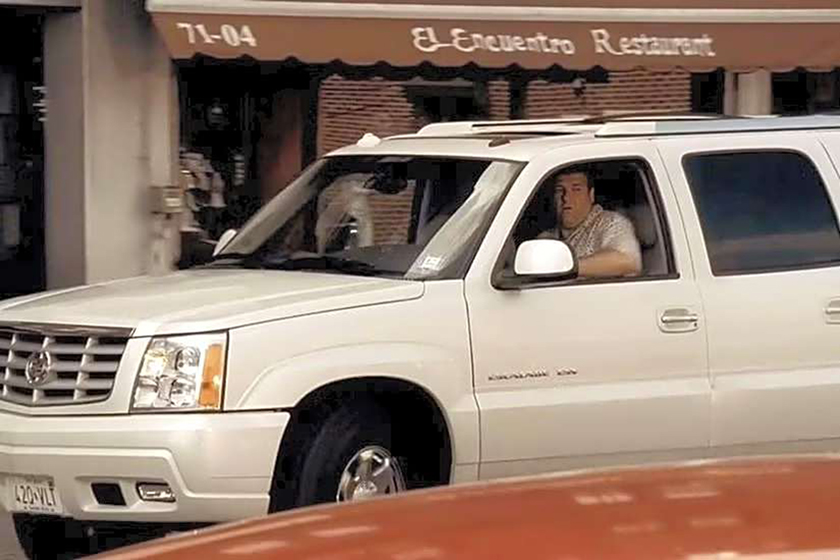
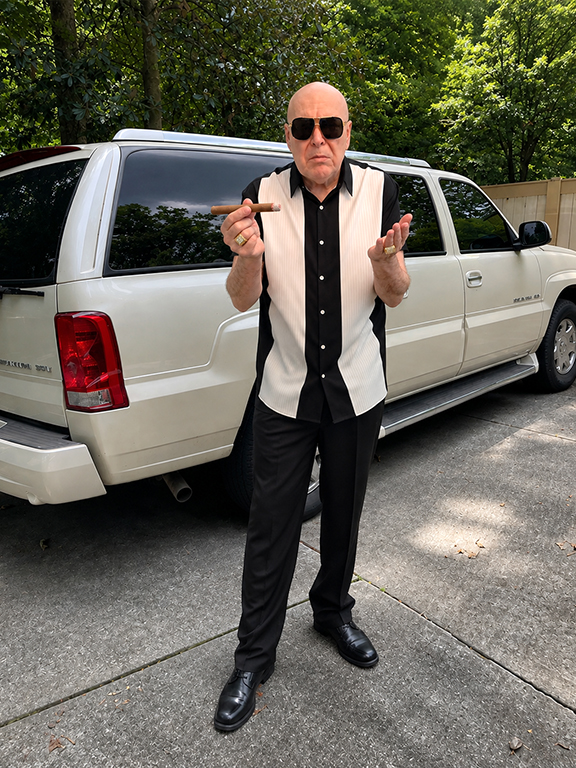
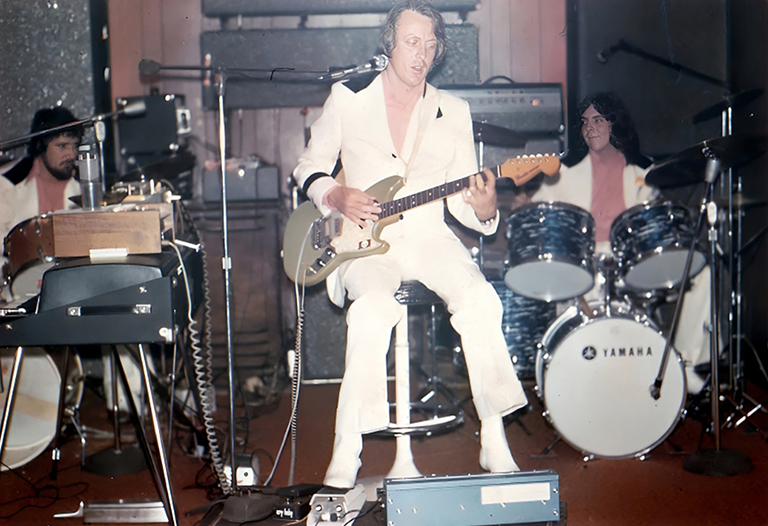
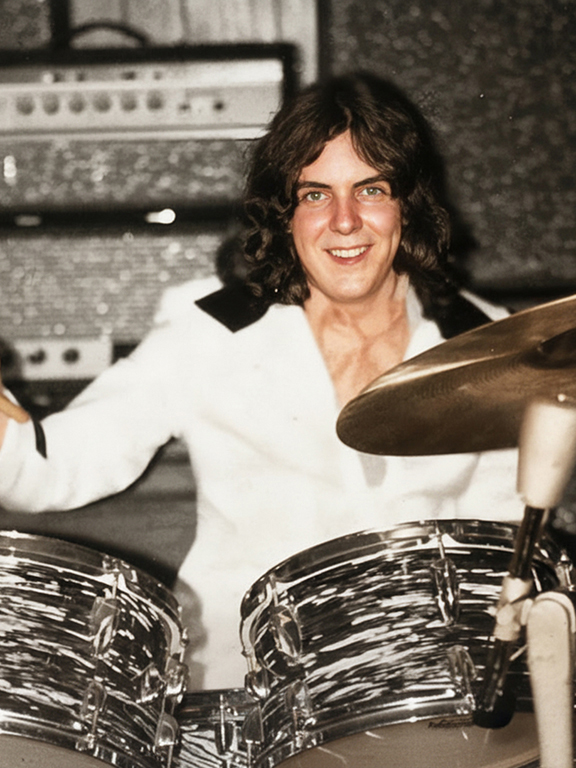
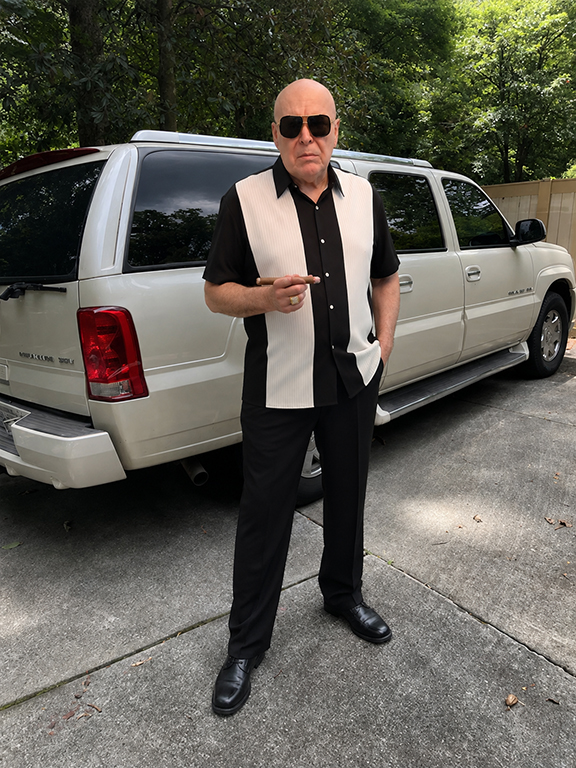
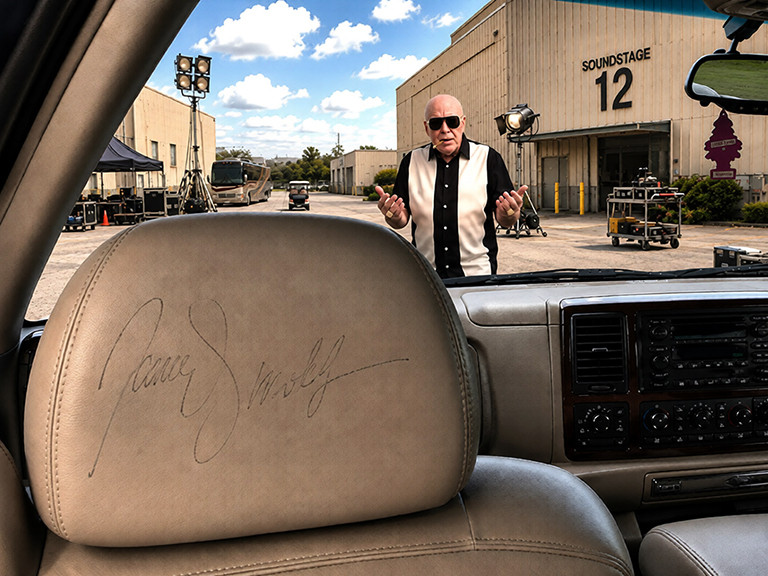
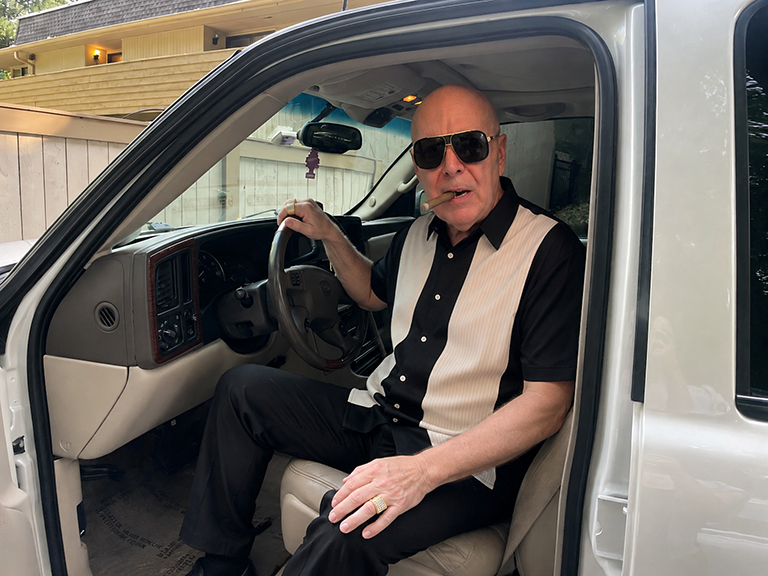
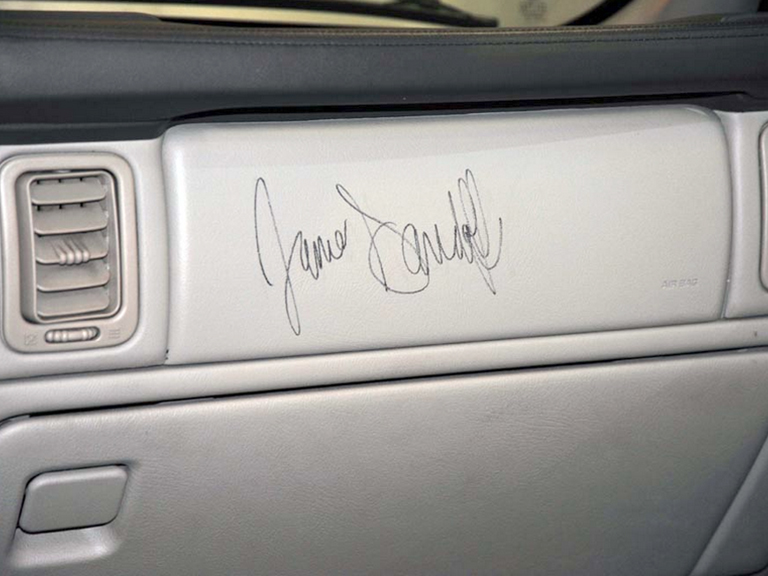
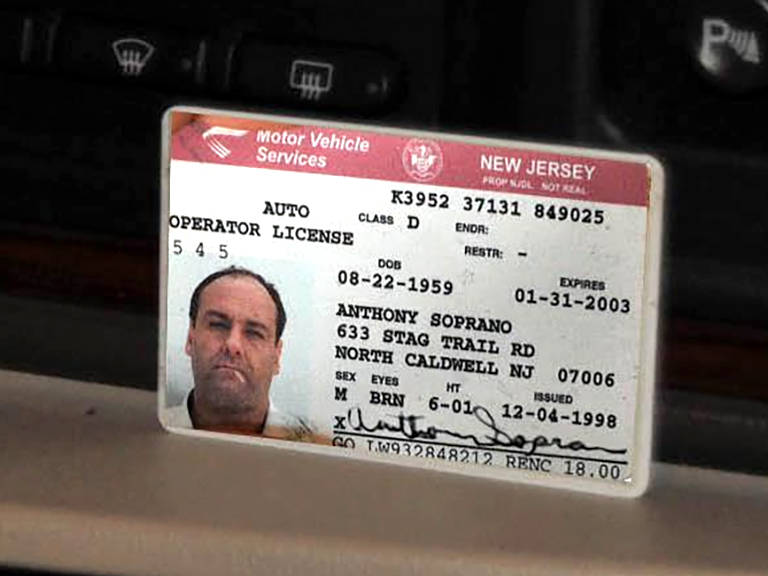
Part 10 of the "From There To Here" album project... Sometimes a seed is planted long before you understand what it is going to grow into.
As part of my From There To Here article series about the ongoing progress of my new album project, I’ve been sharing the people, places, memories, experiences, and creative processes—from songwriting to production—that are shaping not only my music but also the making of this album. These are my stories, told from my perspective as the artist, songwriter, and producer, as I continue making my way from there to here—and because this journey is still unfolding, the story is being written as it happens.
When I wrote the first installment about my co-producer, Edd Miller, I was introducing you to the man, his musical background, and how he became part of my journey. At the time, I didn't necessarily know that another story about Edd would eventually be told.
Perhaps this story is simply the result of some serious musing on my part—something that seems to happen more and more as this album continues to take shape. As From There To Here progresses toward to becoming a recorded album, I have a much clearer understanding of one of the most important roles Edd can play in this project.
I call him The Sonic Guardian.
That's not a title I give lightly.
Edd is a veteran recording engineer first. He has spent years understanding how sound is captured, how instruments translate through microphones and recording equipment, and how the choices made in the live room, where the music is recorded, can ultimately determine what the listener hears.
In the grand scheme of the professional audio world, I believe Edd belongs to a relatively small and elite group of recording engineers whose abilities go beyond technical knowledge. They possess something that technical training alone cannot provide: the natural gift of hearing music—the ability to hear the individual character of an instrument, recognize when it sounds exactly as it should or when something isn't quite right—and understand what needs to be done to capture it authentically.
The technical aspects of recording can be learned. The ability to truly hear music in this way is something else. That kind of hearing is a gift.
Edd has it.
And that expertise is why I believe his role as The Sonic Guardian is perhaps the most vital contribution he can make to From There To Here.
My vision is for me, Sparky, Bart, and Randy to play together live, in the moment, allowing the music to develop naturally between us. I've chosen these musicians because they don't simply play their instruments—they live what they play. They are deeply creative musicians, and I believe the best thing Edd and I can do is give them the freedom to be themselves.
That same philosophy applies to the sound of the record itself.
Edd has been sharing some of his previous work with me, allowing me to listen and see whether there are sounds or recording approaches from his past projects that might provide a template for something I would like him to try. I appreciate that immensely, because it gives me another window into his experience and the sounds he has captured over the years. But the truth is, I had already listened to a substantial body of Edd's work before we ever had our first conversation about this project, and what I heard gave me all the confidence I needed in his ability to hear and capture instruments in the studio. In fact, if I didn't have that level of confidence in his abilities, neither this article nor the first article in this series would have been written.
But looking backward is not really what From There To Here is about.
Yes, there are elements of the past that matter to this project—particularly the analog recording techniques and approaches we plan to incorporate. But beyond that, I don't want us trying to recreate something that has already been done. I want the tonality of the instruments, the vibe, and the sonic energy of this record to come from an in-the-moment capture of us musicians playing together.
I think keeping the recording process as simple as possible—using little to no outboard signal processing on the instruments and vocals as they are being recorded, so the natural tones coming from the microphones and direct signal paths remain intact—is key to the final outcome. Because once signal processing such as compression, echo, reverb, or similar effects is committed to the recording, it becomes part of what was captured and cannot simply be removed later if it isn't serving the music. I would rather preserve the natural sound at the source and make those processing decisions later, when we can hear the entire performance in the context of the finished recording.
I want you, the listener, to be able to step inside that moment when you hear the finished recording—to feel that something fresh is happening, something that wasn't simply pulled from a template or borrowed from another record.
In other words, Edd and I aren't looking backward for the sound of From There To Here.
We're going to let it happen.
We're going to land on a new musical planet, tonally and sonically, and discover what it sounds like together.
In that environment, the music may very well produce itself. That means the less either Edd or I have to impose on the music, the better. Our job is to create the conditions for authentic magic to happen and then recognize it when it does. I don't want these recordings to simply sound good. I want them to sound right.
There is a difference.
Every instrument has its own character. Every musician brings something unique to a performance. The sound coming through the speakers should faithfully represent what was actually played in that room. If the character of an instrument is altered when it reaches the control room, we have already lost something that can't easily be put back later, if at all.
Professional recording is expensive. Every hour in a studio represents an investment of money, time, musicianship, and preparation. The last thing I want is to spend that investment recording a song, walk into the control room for the first listen, and discover that the instruments don't sound remotely like the instruments we intended to record.
I don't want to fix that afterward. I want to get it right at the source.
A recording engineer can be highly skilled and still have a particular sonic perspective. Different styles of music require different approaches, and what works beautifully for one style may not serve another. From There To Here has its own musical language.
That's why I want Edd beside the engineer—not to diminish the engineer's expertise and not to tell someone how to do their job.
I want another set of highly trained ears in the room—ears belonging to someone who understands what I am trying to accomplish musically and can help make sure that vision survives the recording process.
That's what I mean by The Sonic Guardian.
Edd's vital role is to help guard the sound before it becomes a recording.
Because once the performance is captured, there are countless things we can do with it. We can mix it. We can shape it. We can master it. We can make creative decisions about how it ultimately reaches the listener.
But there is one thing we can't do very well: We can't recreate authenticity that was never captured in the first place.
For From There To Here, I don't want to recreate something later. I want to capture it honestly from the beginning.
That's the seed that was planted back in Part 1 when I first introduced you to Edd Miller.
Now, as this album moves from the stories of my past into the present, with a few unrelated side roads explored along the way, and toward the reality of making the record, that seed has grown into something much clearer. I have a much deeper appreciation for why Edd is part of this project and for the ways his production experience, ideas, and creative perspective could contribute to the process. But of all the things Edd brings to From There To Here, I believe his ability to hear, understand, capture, and protect the authenticity and integrity of the sound may ultimately be his most vital contribution.
And when the first notes of From There To Here finally come through the studio monitors, I want to know that what we're hearing is the honest result of what happened in that room—the musicians, the instruments, the energy, and the moment itself.
Not something manufactured afterward. Not something recreated from a template. Something that happened once, in that room, and was captured honestly. Because that's what From There To Here is ultimately about.
Taking everything I've lived, everything these musicians bring with them, and everything that happens when we finally come together—and allowing it to become something that could only have been created there, at that moment, by those people.
And if we get that right, then perhaps the listener won't just hear the record.
They'll feel like they were there.
- Stevie Hawkins

Part 11 of the ongoing Stevie Hawkins "From There To Here" album project...
After making quite a few albums over the years, I'm certainly no stranger to the process. I know the territory. I know that songs rarely travel in a straight line from idea to finished recording, and I know that making an album involves a seemingly endless number of creative choices along the way.
But every album has its own personality, and From There To Here has been reminding me of another dimension of that process—the wonderfully subjective, occasionally obsessive, and sometimes downright odd collection of choices that can shape where a song ultimately ends up.
It's the part of the journey where inspiration and second-guessing tend to travel together. Where a perfectly reasonable musical decision can suddenly lead you somewhere completely unexpected. Where you can spend an unreasonable amount of time wondering whether one tiny change will make a song better, only to put it back exactly where, or as it was.
I've come to realize that making an album is a bit like following the Yellow Brick Road. You start out with a destination in mind. You have a song, an idea, perhaps even a vague notion of what you think the finished thing should sound like. And then you start walking.
Somewhere along this particular Yellow Brick Road, I have apparently appointed myself The Almighty Odd. I don't remember holding an election, but I seem to have won.
The Yellow Brick Road:
In theory, the road should be fairly straightforward: write the song, arrange the song, record the song, and move on. Simple, right?
Not so much.
My particular Yellow Brick Road has a habit of wandering off into the bushes and muse-acres. A chord change catches my attention. A vocal phrase doesn't quite feel right. An arrangement that seemed perfectly sensible yesterday suddenly seems to require an entirely different approach. Before I know it, I'm somewhere down the road asking myself how I got there in the first place.
But sometimes that's where the interesting stuff is. The creative mind has its own peculiar logic, and I've learned that trying to keep it on a leash isn't always the best idea.
The Flying Monkeys:
Then there are the flying monkeys. They're the little thoughts that swoop in just when you think you've got something figured out.
Have you considered changing that? What if the vocal came in here instead? Maybe the whole thing needs to be slower. You know what would really be interesting...?
They are relentless. And occasionally, they're right. That's the maddening part.
They also seem to have an endless supply of straw, which they gleefully toss onto whatever musical fire I've finally managed to get under control. Before long, they've dumped enough of it around the place to build an overstuffed Scarecrow.
Perhaps they're just trying to help me build a brain. I'm not entirely convinced I need another one.
This is what I think of as creative subjectivity. I don't believe there has ever been a lyrical song written that I, or another creative person, couldn't hear differently—where we couldn't imagine a different word, a different line, a different melodic phrase, or some other way of expressing the same idea.
There is always another possibility. Another interpretation. Another direction the song could take.
And that's both the wonderful and frustrating part of it.
From There To Here is a personal journey, so I have to trust my own compass. Ultimately, I'm the one walking this particular Yellow Brick Road. I have to follow it wherever it leads—and discover for myself where this road eventually takes me.
The Crystal Ball:
Then there is the crystal ball.
Every now and then, I find myself trying to predict what a song is going to become before I've actually made it. I can hear a version of it in my head, see where it might go, convince myself that I know exactly what I'm doing, and, for a brief moment, think, "I'll get you, my little pretty!"
Then I listen back.
The crystal ball, it turns out, has never been particularly reliable.
Behind the Curtain:
Eventually, someone has to pull back the curtain. And that's where the reality of making this album lives.
There isn't always a grand plan. Sometimes there is just me, listening to something for the fiftieth time and wondering why I'm obsessing over a detail that nobody else may ever notice. My life's love and soulmate, Charlotte, has lived with this particular affliction of mine long enough to provide corroborating evidence.
Sometimes I'm convinced that moving one tiny thing will transform the entire song. Sometimes I move it, listen again, and move it right back.
This is where I need the brains to figure something out, the heart to know when something feels right, and the lionly courage to stop tinkering and say, "That's enough. Leave it alone."
That last one may be the hardest.
Perhaps that's the real secret behind the Wizard of Odd. From the outside, it can look as though there is a plan. Behind the curtain, however, it's mostly levers, knobs, crossed fingers, long hours, and an alarming amount of second-guessing.
Pay no attention to that man behind the curtain!
Down the Rabbit Hole:
There are also those rabbit holes. I am exceptionally good at finding them. In fact, I'm beginning to suspect I may be the cartographer who drew the map—and then hid it from myself.
I can start out wondering whether a vocal needs one tiny adjustment and, before long, find myself contemplating an entirely different arrangement, a new instrument, or some obscure production idea that has absolutely nothing to do with the problem I was trying to solve.
I continue to learn that not every thought needs a new hole dug or deserves to become a project. This is an important lesson for someone whose brain apparently regards every passing musical notion as a potential adventure. Still, every once in a while, one of those seemingly ridiculous detours turns out to be exactly what the song needed.
So perhaps the rabbit holes aren't entirely bad.
Somewhere Over the Rainbow:
Then, every once in a while, something happens.
The elusive melody, lyric, or metaphor you've been chasing suddenly appears—not necessarily because you finally figured it out, but because you stumbled upon it.
A melody takes shape. A vocal finds its character. An arrangement suddenly makes sense. Something clicks.
For a moment, you can hear the song you imagined somewhere over the rainbow.
You may not have captured all of it yet, but you can see where you're going. And that's usually enough to keep walking.
The Emerald City:
Of course, somewhere out there is the Emerald City: the finished album.
It looks tantalizingly close from here, particularly on the days when everything seems to be falling into place. Then you take another step and realize there's still quite a road ahead.
From There To Here is very much still a work in progress. There is still distance to travel and plenty more to discover before I reach the end of the Yellow Brick Road, and I'm quite certain there are more flying monkeys waiting for me around the next bend.
But the wandering is part of it. The obsession is part of it. The wondering is part of it. And even the occasional "What the heck was I thinking?" is part of it.
And maybe that's why I've come to embrace the oddness.
Because somewhere between the road, the monkeys, the crystal ball, the curtain, and the rainbow, there is a song waiting to find its way home.
No Place Like Home:
Perhaps the best moment comes when you stop trying to force a song to become what you thought it should be.
Instead, it becomes itself. That's when it feels like you've finally brought it home.
Maybe that's the real trick of the journey. You don't necessarily arrive where you thought you were going. You arrive somewhere that feels right—and that is always my final destination.
So, yes, I'm still walking the Yellow Brick Road. The Emerald City is somewhere ahead, the flying monkeys are circling overhead with their seemingly endless supply of straw, the crystal ball remains questionable, and the curtain is still hiding whatever is really going on back there.
I have no idea exactly where I'm going, and that is the best place to start.
The Almighty Odd has spoken.
Ask me again tomorrow.
- Stevie Hawkins
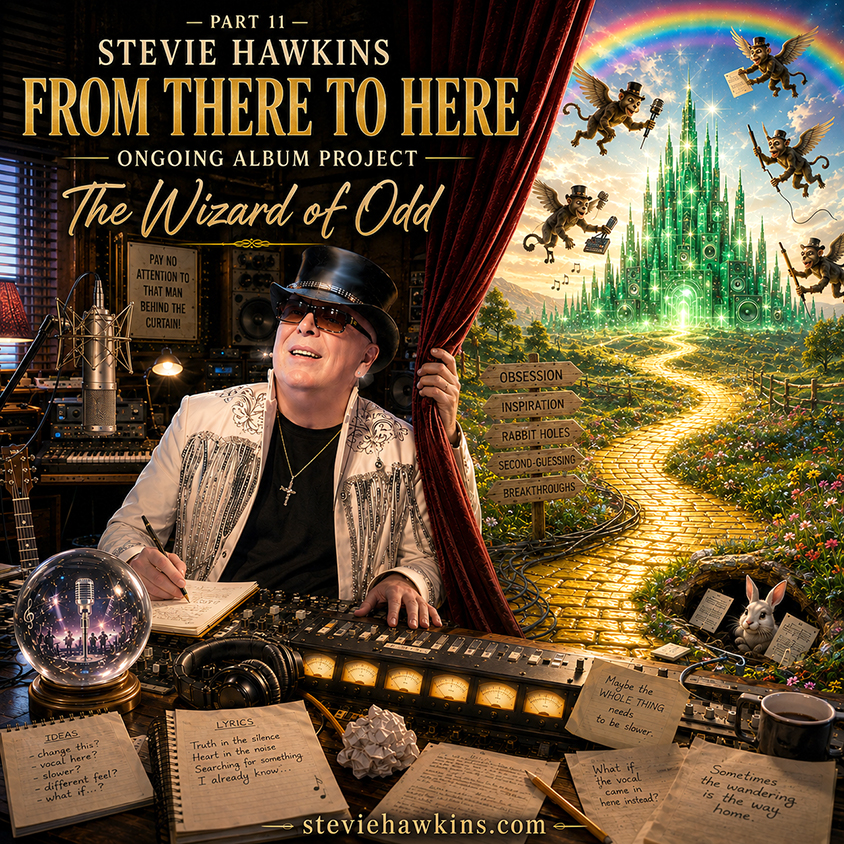
Part 12 of the ongoing Stevie Hawkins "From There To Here" album project...
This week, I’m dragging you into my chaotic home-studio bunker for a behind-the-scenes look at the vocal demo recording process for the new album—complete with questionable warm-ups, questionable high notes, and the occasional reminder that microphones and audio recorders have excellent memories!
Until recently, recording demo vocals at home wasn't really part of my songwriting process. That has now changed.
I've started recording the demo vocals for the songs on the new album myself at home, and they're becoming an important part of how I learn and develop each song. These aren't the final vocals, and they're not supposed to be. They're guides that help me get familiar with the melodies, lyrics, phrasing, timing, and overall feel of each song before I eventually step into the studio to record the final vocals.
But these demos do more than simply help me learn the songs.
They help me “find” the songs.
They also become an important development reference for the creative team, giving them something tangible to shape the songs and varied performances.
And, occasionally, the demos help me discover things about my own singing that I might have preferred not to know. "Needs work!"
The First Rule of Demo Club: Just Sing:
I've been recording my own vocals for decades, so the actual process of standing in front of a microphone and singing into it isn't exactly new territory for me. The interesting part is what happens when these particular songs are still taking shape.
The first step is incredibly simple:
Sing the song.
That's it. No deep philosophical explanation, no complicated vocal strategy, and no secret formula. And unfortunately, there is no little committee of magical songbirds that appears outside the studio window to sing the melody for me!
I have to do it myself.
I sing the melody as I first heard it, usually taking the song from beginning to end. That first pass gives me a basic roadmap, capturing the shape of the vocal and giving me something concrete to listen back to.
There is a big difference between “hearing” a vocal in your head and actually hearing yourself sing it.
When I'm writing lyrics, I'm usually hearing the melody at the same time. I'm imagining where a phrase rises and falls, which words need emphasis, where the emotion builds, and where it needs to pull back. The lyrics and melody tend to arrive together, but until I actually sing them, they're still living inside my head.
And as we all know, things can sound absolutely brilliant inside your head.
Then you press record, and reality enters the room.
Meet My Least Favorite Bandmate: Playback:
There is something strangely revealing about hearing your own voice played back.
While you're singing, you're inside the performance. You're thinking about the melody, the lyrics, the timing, the pitch, and the next line that's coming at you like a train you can't miss.
Then you stop and listen, and suddenly you can hear things you didn't notice while you were singing.
Maybe a phrase sounds too cautious. Maybe a note needs more confidence. One minute you think you've captured pure emotional magic, and the next, your headphones play back something resembling a banshee having a midlife crisis.
You start questioning whether your beautiful, soulful vibrato is actually just caterwauling into the void!
Sometimes everything is technically right—the notes, the timing, the melody—but something still feels wrong. That's usually the more interesting problem because then I'm not trying to fix a mistake.
I'm trying to figure out what the song is asking me to do.
Of course, there are also the things the song is asking me to do that have absolutely nothing to do with music.
Like stopping because the neighbor has decided that my carefully constructed vocal atmosphere would sound much better with a lawnmower in the background.
Or because old Chester the yellow yard dog has suddenly discovered that there is an extremely suspicious squirrel somewhere in the universe, and it is apparently my responsibility to know about it.
That's part of the charm of recording at home. You may be trying to capture an intimate vocal performance about something deeply personal while somewhere outside your window a leaf blower is achieving a level of emotional intensity you didn't know was possible.
Apparently, even the home studio has a co-production team.
Now Try It Again. And Again. And Again.:
This is where the experimenting begins.
I'll sing the same section several different ways, changing the phrasing, altering the dynamics, putting more emphasis on one word and less on another, holding a note longer, letting another one go sooner, or approaching a phrase with restraint before trying it again with more emotion.
Sometimes I'll even change the melody slightly. Not because the original melody is necessarily wrong, but because singing it can reveal something I couldn't hear while I was writing it. There is a difference between knowing a melody and actually inhabiting it.
And the same thing can happen with the lyrics.
During the demo process, I sometimes discover that a word, a line, or even an entire section needs to change. Something that made perfect sense when I was writing it can suddenly feel completely different once I actually sing it.
Sometimes the fix is simple. A different word. A different syllable count. A rewritten line. A small change that makes the lyric flow better or says what I actually meant.
But there have already been two songs where I ended up writing entirely new lyrics after recording the demos. In both cases, I wasn't comfortable with where the story had ended up, or with what the lyric was saying as a whole.
That's one of the useful—and occasionally inconvenient—things about actually singing the songs. You can't always hide from a lyric once you're standing there delivering it. If the story doesn't feel right, or the words don't sound like something I really want to say, the microphone has a funny way of pointing that out.
So sometimes the answer isn't to sing the lyric better.
It's to rewrite the darn thing.
The written melody gives you the road; the performance determines how you travel it. Sometimes you take the scenic route, sometimes you miss the exit entirely, and sometimes you end up wondering why you took this particular road in the first place.
The important thing is that singing the song gives me information that simply writing it can't. A verse might become quieter and more conversational. A chorus might open up. A single note might become more vulnerable. The melody may remain almost exactly the same, but the delivery changes the meaning.
That's when the melody starts becoming mine.
The Ridiculous Number of Decisions in One Line:
This is one of those parts of making music that can be difficult to explain from the outside.
Someone hears a finished vocal and thinks, “Well, he just sang the song.”
Technically, that's true.
But there's a lot hiding inside those few minutes of finished music.
Finding the right vocal can take minutes or can take hours. You're not simply trying to hit the notes. You're trying to find the combination of pitch, rhythm, tone, phrasing, dynamics, emotion, and personality that makes the performance believable.
There can be dozens of tiny decisions inside a single line.
How much air goes into the word? How hard do I attack the note? Should this phrase feel intimate or powerful? Should I let the emotion show, or hold it back? Where should I breathe? Which word matters most?
And sometimes the answer isn't to do more.
Sometimes it's to do less—a slight smile in the voice, a breath before a lyric, a little extra weight on one word, a moment of vulnerability, or simply a decision not to push. Those tiny choices can completely change the character of a performance, and they're also the kinds of things most listeners will never consciously notice. You can spend an hour obsessing over something that a listener experiences as:
“That sounds good.”
And that's exactly what you want.
Eventually, You Have to Shut Up and Sing:
I’ve discovered that the more I think about what I’m going to sing, the worse the odds become that I’ll actually sing it well.
So eventually I just have to channel my inner Jedi, stop thinking, open my mouth, and trust the Force. Whatever comes out, comes out. And more often than not, that completely unplanned vocal is the one that defines the song. Apparently, the less supervision I give my voice, the better it behaves!
That can be the moment everything starts to fall into place.
The conscious part of my brain finally gets out of the way, and instinct takes over. I'm no longer thinking about whether the phrase is technically and pitch correct or whether I'm making the perfect choice.
I'm responding to the song.
It's almost contradictory. You can spend hours thinking about every detail of a performance, only to discover that the breakthrough comes when you stop thinking about it altogether. That is how approach playing drums singing live. But the studio environment is quite different for singing live.
But all those hours weren't wasted.
The experimenting taught me what didn't work. The repetition made the melody familiar. The listening helped me understand what the song was trying to tell me.
Eventually, there was enough information stored away that instinct could take over.
The brain did its job.
Then, thankfully, it got out of the way.
Of course, there is another possibility: you stop thinking because you've sung the same line so many times that your brain has simply filed for retirement.
Either way, the result can be surprisingly productive.
The Demo Has a Job:
Once a demo vocal starts to feel right, it becomes much more than a placeholder.
It becomes a creative roadmap. It shows me where the emotional center of the song is, gives the vocal a shape, and documents the direction I'm heading.
The demo doesn't have to be perfect.
Actually, it shouldn't be.
Its job isn't to prove that I've already finished the song; its job is to help reveal what the song could become.
In some ways, I think of the demo as the musical equivalent of a pencil sketch. You don't frame the sketch and call it the finished painting. You use it to figure out where everything belongs before you start adding all the detail.
And if the sketch happens to contain a few questionable vocal decisions, those can stay between me, the microphone, and the delete button.
Before the Real Microphone:
Once the main recording sessions for the album are complete, I'll move toward recording the final vocals.
By then, I'll have spent considerably more time living with these songs. I'll know the melodies and lyrics, I'll know where the difficult passages are lurking and waiting to ambush me, and I'll have experimented with phrasing, dynamics, emotion, and delivery.
I'll have a much clearer idea of how I want to approach each song.
The final recording will still be its own moment. A different production, instrumentation, additional musicians, harmonies, backing vocals, and all the other elements that come together to create the finished record will bring new possibilities.
But underneath all of that will be the work I've already done with these home recordings.
The demo will have helped me get there.
By that point, I'll hopefully know what I'm trying to accomplish before I step up to the microphone. That doesn't mean every take will magically fall into place. There will still be moments when I hear something back and think:
“Well, that certainly wasn't what I had in mind.”
And that's when it's tempting to believe the tuning fairies will fly down from the ceiling tiles and magically fix your pitch. Unfortunately, those little rascals never seem to show up when you actually need them.
The real solution is usually much less magical: listen, adjust, try again, and keep working until the performance sounds and feels right.
That's what the demo process is helping me prepare for. The less I have to figure out when I get to recording the final vocals, the happier I will be.
After all, my microphone has heard enough of my emotional breakdowns and cursing the vocal spirits to file a restraining order.
From Idea to Something Real:
I've only recently started recording these demo vocals at home, so I'll be discovering what they reveal for the next short while. So far, it's been a lot of work, but I am happy with the results.
Using the demos as a practical way to learn the songs is simply another part of the creative process. And sometimes, after all the experimenting, second-guessing, and questionable vocal decisions, something changes.
I stop analyzing.
I stop searching.
I stop trying to make the vocal happen.
I simply sing.
For a while, everything gets quiet.
No lawnmower. No barking dog. No leaf blower. No imaginary songbirds.
Just me and the song.
And somehow, the song seems to tell me exactly how it wants to be heard.
That's the voice I'm looking for.
And, apparently, I'm going to have to sing my way there—one slightly questionable demo vocal at a time.
- Stevie Hawkins
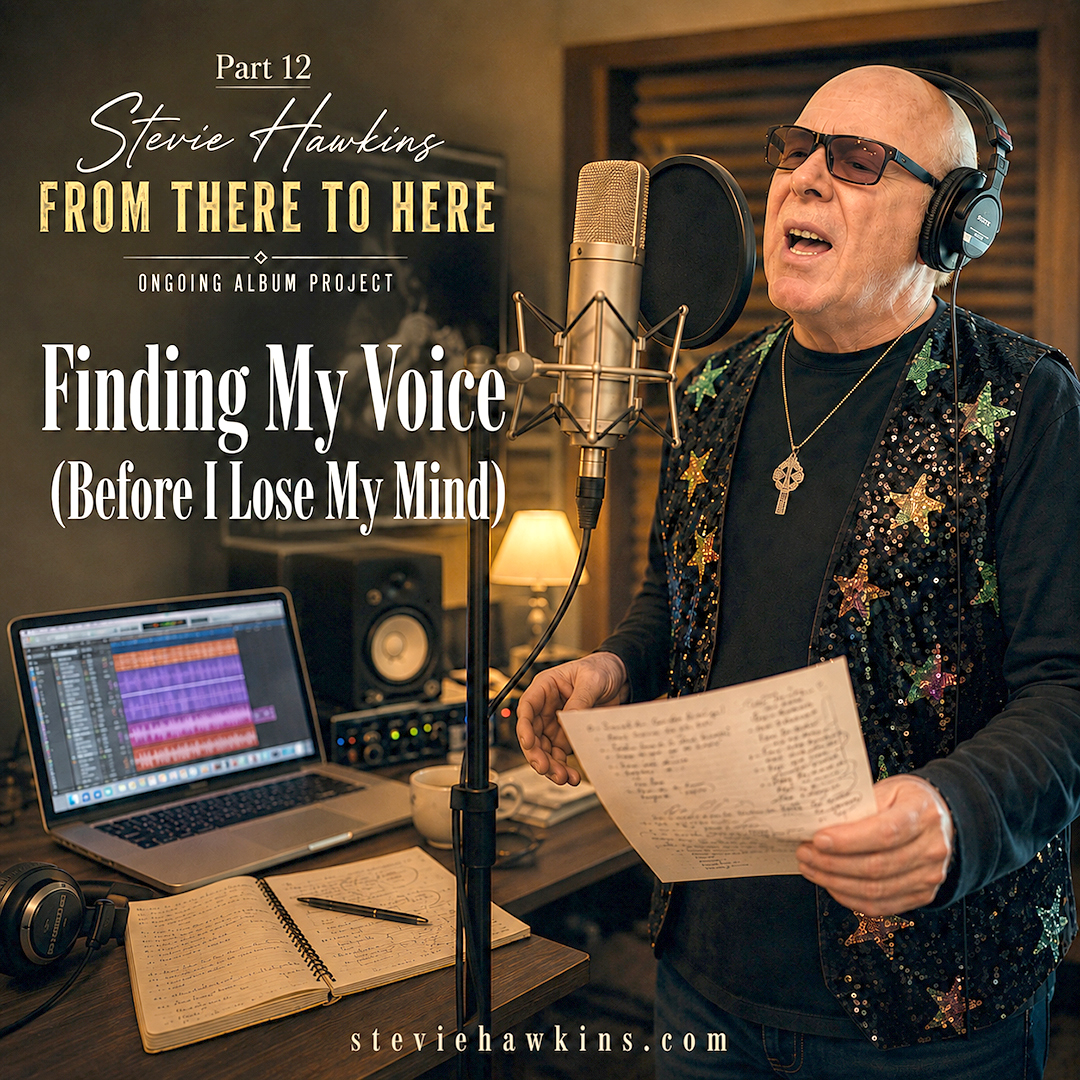
Part 13 of the ongoing Stevie Hawkins "From There To Here" album project...
I think there's somebody else writing this album. I don't know who it is. I just know it isn't always me.
I've started calling it the Ghost in the Machine.
Now, when I say "the machine," I'm talking about the mind—the machinery inside all of us that somehow takes thought, memory, instinct, emotion, reason, and imagination and turns it into something we recognize as us. I'm not interested in trying to explain the brain or wander off into neuroscience. I've spent enough time trying to understand my own brain and for dang sure, I'm not about to volunteer to explain everybody else's.
I'm talking about the mind as a songwriter.
In my own way of making sense of the mind, the Ghost has a crew—three different voices or forces working inside the machine, each doing a different job. One reacts. One reasons. One reaches deeper and somehow finds things I didn't consciously know I was looking for. I don't pretend to know exactly how any of that works. Honestly, some days I'm still trying to figure out how my brain can remember a melody I heard once in 1972 but forget what I came into the room to do today.
I just know they all seem to show up when I write.
And somewhere among them is the Ghost.
Maybe the Ghost isn't separate from the machine at all. Maybe it's what happens when all those pieces start talking to each other—instinct, memory, experience, emotion, and imagination working behind the curtain. Or maybe "the Ghost" is simply the best name I've found for that strange creative voice.
Whatever those characters are cooking up in there, I've learned to stay out of the kitchen.
I've argued with it before. That's how I know.
When I first started this project, I knew what I was making: a blues album.
I love the blues. I've played blues music for most of my career, and I have more than a passing familiarity with the genre. I've even been fortunate enough to be inducted into the Alabama chapter of the Blues Hall of Fame as a "Legendary Blues Artist."
So when I decided to start writing for this project, a blues record wasn't a crazy idea. It was the obvious idea. I had a direction. I had a plan.
This was going to be simple. I'd write some blues songs, record them, put them on an album, and move on working toward booking tour dates in 2027.
Bless my little naïve heart!
Then the Ghost showed up—not literally, of course. At least I don't think so. I'm not talking about Casper the Ghost, either. If Casper starts helping me with the arrangements, I'll have bigger questions. Like whether ghosts are covered by my health insurance!
That was around the time I began to feel guided through the songwriting for this entire album project. Something started happening every time I sat down to write. I'd begin with the intention of writing a blues song—a lyric idea, a thought, maybe a story I wanted to tell. Then, somewhere along the way, the song would take a left turn.
A melody would appear that wasn't part of the plan. A lyric would start heading somewhere more personal. An emotion would show up that I hadn't invited into the room. And the song would essentially look at me and say:
"That's not where we're going."
The Ghost doesn't say, "That's a bad song."
So I follow its lead, and before long, I’m somewhere I never planned to go. So I follow its lead, and before long, I’m somewhere I never planned to go. And apparently, I'm expected to act like this was the plan all along.
The First Turn
The first real lesson came with the very first song.
I started with an idea that could have easily lived inside a stone-blues lyric. It had all the ingredients: secrets, human behavior, things said, and things left unsaid. I knew the kind of song I thought I was going to write.
Then the Ghost started messing with me. The lyric wouldn't stay put. Instead of digging deeper into the original idea, the idea began moving. First through a town. Then out into the countryside. Then somewhere deeper—into memories, emotions, and the things that happen inside your head when you're alone with your thoughts.
Before I knew it, the song wasn't really about the thing I'd started writing about at all. It had become a journey.
The road became the metaphor. The destination became less important than the choice to get moving and see where the road takes me. At its heart, the lyric became about freeing the heart, the mind, and the soul enough to take the road that feels right.
That wasn't the song I sat down to write. Which, I'm discovering, is becoming a fairly common occurance around here. Apparently, that was the song I needed to write.
There's something humbling about sitting down convinced you're the songwriter and discovering you're actually the Ghost's personal creative transcription service!
And that was my first real introduction to the Ghost in the Machine as part of the From There To Here album project.
Meet the Committee
Now, before anyone with a neuroscience degree starts reaching for their keyboard, I'm not suggesting the brain literally works this way. I'm using a very simplified model because, as a songwriter, I find it useful. If you disagree, please direct your rebuttal to the Ghost. Besides, it gives me someone else to blame.
With this particular project, I think of the songwriting process as three voices in the room.
First, there's the Architect. The Architect worries about words, structure, rhyme, meter, chords, and all the other things that turn an idea into an actual song. The Architect is useful. And also a pain in the rear.
You can finally write a line that feels great, and the Architect immediately points out that it has one syllable too many or:
"That doesn't rhyme."
Thank you, Architect. Nobody asked.
Then there's the Dreamer. Melody, emotion, memory, intuition. The part that doesn't necessarily know why something works. It just knows that it does.
The Dreamer doesn't carry a clipboard. The Dreamer probably couldn't find the clipboard if you gave it a map. It's also the reason I can stare into space for twenty minutes and call it songwriting.
And then there's the Groover. The Groover isn't particularly interested in grammar or clever wordplay. The Groover wants to know one thing:
Does it feel good? Does it move? Does it make you tap your foot? Does the pocket feel right?
As a drummer, I tend to trust the Groover. Probably more than I should. The Groover has never once cared whether a lyric is good, bad, or indifferent. Give it a good pocket and it is perfectly happy.
So there I am, in the middle of this committee.
The Architect wants a plan.
The Dreamer wants to follow the feeling.
The Groover wants the song to move.
And I'm sitting there trying to keep everybody from talking at once.
And then there's, the Ghost.
So Who Is the Ghost?
Maybe the Ghost is what happens when those three voices start talking to each other. And occasionally, they all agree.
That's when things get interesting. The song suddenly feels inevitable. You don't know exactly why. You just know you've found it.
Maybe that's the part of songwriting we can't completely explain. Maybe sometimes the Ghost is more than instinct or memory—a spiritual presence, perhaps, a quiet voice that seems to guide me without ever revealing its source. I don't need to give it a name, a religion, or even an explanation. I just know that something is leading me somewhere I didn't know I needed to go.
Those are the moments every songwriter chases. The moments when you stop wrestling with the song and realize the song is carrying you.
That's been a constant for me throughout writing the songs for this album. Again and again, I've sat down thinking I knew where a song was going, only to find myself somewhere else entirely. A different lyric. A different emotion. A song that seemed to reveal what I didn’t know I was trying to say.
I've learned that those moments aren't interruptions in the process.
They are the process.
That's when I stop trying to steer, let go, start listening, let whatever comes next simply unfold.
We like to think we're in charge. We sit down with our pencils, instruments, our notebooks, our computers, and our carefully considered plans. Then some little voice inside says:
"Stevie... we're not doing that."
It's a little like handing a contractor a blueprint and having him look at it for a minute before saying, "Nice plan. We're going to build something else." And the interesting thing is, that change of focus is ever so often correct.
That's what happened to me with From There To Here.
The plan was a blues album.
But the more I wrote, the more personal the songs became—not because I decided one morning that I should make an album about my life, but because the songs simply kept uncovering pieces of the journey.
Eventually, I realized that's what this record was becoming.
The first song showed me that the lyric could lead the music somewhere I hadn't expected. The next songs reinforced that something was happening.
And recently, it happened again.
This time, the lyric took another unexpected turn, but the music didn't follow it. The music stayed right where it wanted to be: a driving shuffle blues track.
Apparently, the Ghost isn't opposed to the blues.
It just has opinions about what I'm supposed to say over it.
Fair enough.
At least we're negotiating now.
I'm beginning to understand that the Ghost doesn't necessarily want to change the song.
It wants to reveal the song.
The Committee Has Opinions
Maybe that's why the three voices matter. You need the Groover to find the pulse, the Dreamer to find the emotion, and the Architect to turn the whole mess into something you can actually record.
The trick is knowing when each one gets the voice. If the Architect takes over too early, you can end up with something technically correct and completely lifeless. If the Dreamer gets everything it wants, you may end up with twelve verses about your childhood and no chorus. Which sounds profound right up until you realize you still have another eleven verses to go.
The Groover, of course, will just be sitting there tapping its foot. It doesn't care. It's happy. The Groover is the easiest member of the committee to please. Give it a good pocket, and it will leave everybody alone.
And sometimes the three of them don't agree at all.
That's when the Ghost seems to have the final word.
Not:
"That's a bad song."
Just:
"That's not where we're going."
I've learned that arguing with the song rarely makes the song better. That only keeps me from hearing what the song is trying to become.
And I've done enough of arguing and second guessing over the years to know when my time is being wasted.
From There To Here
Maybe that's the real reason the title of this project feels more appropriate to me now than it did when I started.
I thought From There To Here was simply about the distance between where I started and where I stand today. It is. But it's also about the unexpected roads between those two points.
The songs have taken some of those roads, and I've followed them. The Ghost never gave me a finished song. It just kept pointing me to the next door. I no longer ask questions. Only open the door.
I suppose that's the songwriter's version of faith: you open the door and trust there is a song waiting on the other side.
Maybe the Ghost is instinct. Maybe it's emotion. Maybe it's experience. Maybe it's all the music I've heard and all the life I've lived, somehow having a conversation underneath the surface. Maybe it's the Groover, the Dreamer, and the Architect finally agreeing on something.
I don't really know.
And I am comfortable with not knowing. That's probably another thing the Ghost has taught me. When the song starts telling me where it wants to go, I listen. I don't always understand the directions. I don't always like where the road leads.
But so far, the Ghost has gotten me somewhere worth being.
- Stevie Hawkins
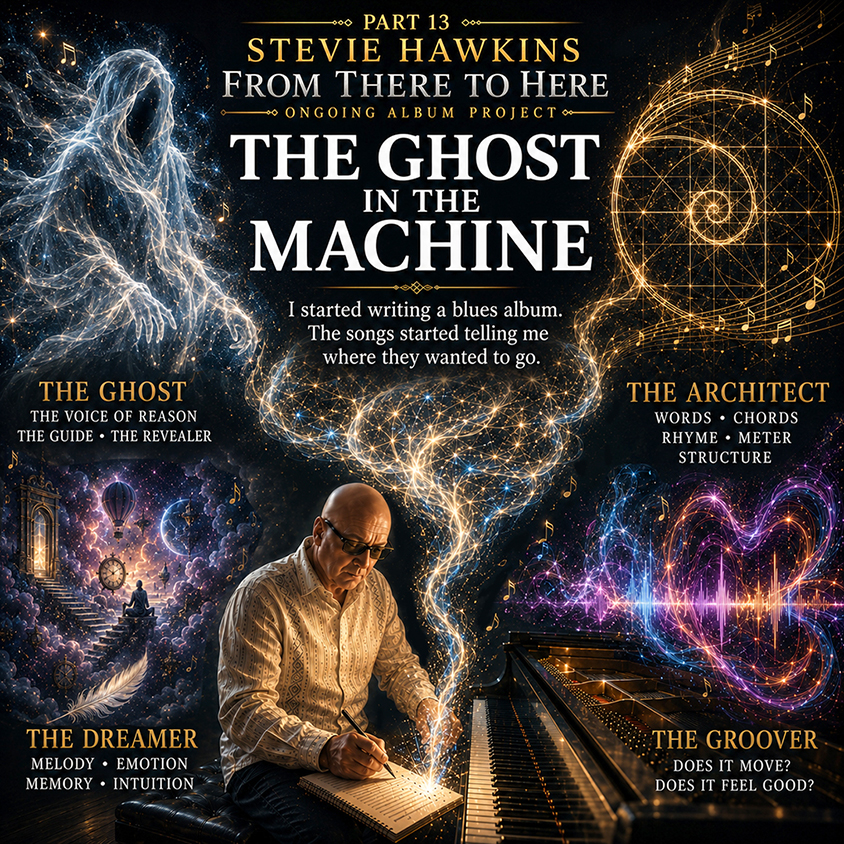
Part 14 of the ongoing Stevie Hawkins "From There To Here" album project...
As I continue working on my new album, From There To Here, I’ve written nearly twenty songs. That’s a good thing. I think. The problem is, there will only be room for 10 or 12 of them, so now the songs are competing for a limited number of seats on the album. And, it seems, they’re taking the fact personally.
My 20 songs walk into a bar.
Well, technically, they’re my songs; I wrote them—my own little family of characters, misfits, overachievers, and questionable life lyric choices. And technically, they’re not supposed to be drinking. They’re supposed to be sitting quietly on my legal pad and computer, patiently awaiting their fate as to whether they make the cut or not for my new album. But apparently, they’ve decided they’ve waited long enough.
So here we are at the Self-Penned-House Bar & Grill, where the lobbying has begun. The songs are abiding by the no drinking rule. Milk, lattes, juices, water, energy drinks, and herbal teas are flowing.
However, the Party Song has thus far acquired 23 demerits and is three beers into a very questionable campaign strategy! The outlook does not bode well for ol' Party Song!
And this, of course, is where things get complicated for me. I wrote these songs, so you’d think I’d know which ones belong on the album. I don’t. Some days I have a clear favorite; other days, a song I’d nearly written off suddenly grabs me by the ear and says, “Hey, remember me?”
Each song has its own personality, its own little argument for why it deserves a spot, and apparently no intention of making this decision easy for me. I’m beginning to suspect that writing twenty songs for an album is a lot like raising twenty children and then being told you can only take ten, twelve tops, on vacation.
And then there’s the small matter of patience—which, apparently, is not a quality any of these songs possesses.
I’m only on vocal demo number five, which means a considerable distance remains from the point to making final decisions for inclusion. There are many more demos to record, songs to revisit, arrangements to rethink, and probably several moments when I’ll fall madly in love with a song I currently have sitting in the “maybe” pile.
But try explaining any of that to twenty songs who have already decided that their demo should be next. Every time I reach for the microphone, I can practically hear them yelling, “Pick me! Pick me!” from the other side of the room.
So, while I’m trying to figure out which songs feel the strongest, which ones work best together, and which ones sound like they actually belong on the same album, the songs themselves have apparently decided to make their cases.
Judging by the activity at the Self-Penned-House Bar & Grill, they’ve decided they’ve waited long enough.
~ The Southern Rock songs have taken over a booth. With wide-eyed excitement, these gentle giants, deeply encouraging, porch philosophers are trying to convince the other songs they are the free birds, the creme de la creme, and the obvious headliner choice.
~ The ballads are sitting together in the corner, quietly sipping their beverages and wondering why nobody appreciates them. One of them keeps saying, "Back in 1994, people understood us."
~ The uptempo songs are being obnoxiously cheerful. They’ve interpreted “bring some energy” as “be as loud as possible.”
~ The odd song is sitting by itself, staring at everyone. I walked over and asked,
“Everything okay?”
“Fine,” said the odd song.
“Are you sure?”
“No.”
It started crying.
Across the room, two acoustic songs were arguing. One was loud and confident. The other subdued, yet equally confident, although nobody had actually asked it to be.
“I’ve got a great chorus,” said the first.
“So do I.”
“Mine comes sooner.”
“That’s not necessarily a good thing,” said the second.
“It’s catchy,” said the first.
“So am I.”
“You’re annoying,” said the first.
“People remember me,” the other shot back.
At the bar, the obvious single song was making its case to the bartender.
“I’m definitely getting on the album.”
The bartender shrugged. “Don’t look at me. I don’t make the decisions.”
“I know,” said the single song. “I’m just working the room.”
She gave him one more smile. Hey, you can’t blame a single for asking!
Meanwhile, one of the deep ballads had begun explaining to anyone who would listen that nobody really writes songs like it anymore and had somehow turned the observation into a full-length lecture. It had been explaining for forty-five minutes.
At the lower side of the bar sits the old-school blues song in a straight-back chair, guitar resting on his lap and a bag of his favorite, Big Jack’s BBQ, at his side. Old-school blues was complaining about modern production.
“Back in my day, we had three chords and a story.”
“You still have three chords,” I said.
“Exactly. But I’d like them to sound expensive,” said the blues song.
Then he took another bite of his BBQ sandwich and added, “And if I’m gonna get cut from the album, I’d at least like some Big Jack's ribs to show for it!”
The lost soul song suddenly stood up and announced,
“I don’t even care if I make the album.”
Nobody looked up.
“Seriously. I’m good either way.”
Still nothing.
“I mean it. If you want to leave me off, that’s totally fine.”
The other songs began looking at each other while smirking and snickering.
“I’m not upset,” it said.
“You seem upset,” I said.
“I’m not.”
“You're yelling," I said.
“I’m passionate.”
“You're crying,” I said.
“It’s a very emotional song.”
Then it sat back down, crossed its arms, and muttered, “I hope you enjoy your little ten or twelve-song album.”
Yeah. It cared.
A sensitive-emotional song beside me that hadn’t said a word finally meekly spoke.
“Do you think I have a shot?”
“I don’t know,” I said.
“Who else is in the running?”
“I haven’t decided.”
“Oh, sure. No pressure.”
It paused.
“I mean, obviously, I’d love to be on the album.”
Another pause.
“But if I’m not, that’s fine.”
“You just said you’d love to be on it.”
“I said I’d love to be on it. I didn’t say I’d be emotionally devastated if I wasn’t.”
It stared at me.
“I’ll be emotionally devastated if I’m not.”
Pouted, then very quietly: “Just thought you should know.”
Meanwhile, the vagabond song I’d almost forgotten about was quietly buying everyone another round. I’m beginning to suspect it has a plan.
I probably should have thought this through before I wrote nearly twenty songs. Of course, there is another option: put all twenty on the album. Twenty songs. That’s not an album; that’s a hostage situation. Then again, I’ve never been particularly good at knowing when to stop. Apparently, neither have the songs.
Suddenly, it’s like a twenty-song town hall with no moderator!
“I’ve got the best melody!”
“My lyrics are better!”
“I’ve got a bridge!”
“I’ve got a hook!”
“I’ve got the catchiest chorus!”
“I’m radio-friendly!”
“I’m not radio-friendly!”
“I’m artistically important!”
“Who said that?”
“I did!”
“Nobody asked you!”
I suppose that’s what happens when you write nearly twenty songs. After a while, they stop being songs and start developing personalities. Some are cocky, some are needy, some are humble, some are sad, some are convinced they’re stars, and some are just plain weird.
AAnd maybe now you can see why this decision is going to be a little harder than it sounds. My team must figure out which songs work best together, which ones deserve a place on the album, and, ultimately, which ones I simply can’t live without. The latter is my concern!
It’s not going to be easy—and no matter what is chosen, several songs will be disappointed. But I suspect the misfit songs won’t be going quietly. Somehow, somewhere, they’ll rise up and demand to be heard. And knowing these rascals, they’ll probably have a pretty good argument if I have anything to do with settling it!!
So, in the words of the late, great Ricky Nelson, “You can’t please everyone, so you’ve got to please yourself.”
Which, as it turns out, is a pretty good thing to remember when you’re the one writing the songs.
- Stevie Hawkins

Part 15 of the ongoing Stevie Hawkins "From There To Here" album project...
The take is over.
I and the guys come back into the control room. Edd is listening, I'm listening, everybody is listening. And for me, that's where the creative conversation begins—not before the take, not while we're trying to decide exactly what the song is supposed to become, but after. Because now we have something real to respond to.
Maybe somebody played something we didn't expect. Maybe a section went somewhere different than we had planned. Maybe there was a mistake that somehow made the performance better. Or maybe nothing happened that we can immediately put into words. We listen again, and then somebody says something. Edd might have an idea. I might have that little internal reaction—a yes, a no, a maybe, or simply the feeling that there's something there we haven't quite figured out yet.
That's the part of making a record that interests me most.
There comes a point in making a record when you have to stop planning it and start listening to it.
That isn't how this album began.
When Edd Miller and I first started talking about the production of this project, we spent several long meetings discussing songs, progression, arrangements, the sound, and the general approach we might take in making the record. At the time, I thought I knew what kind of album I was going to make.
Then I wrote the third song, and somewhere around that point, the whole thing began to change.
The demos started moving dramatically in another direction—not just in the songs themselves, but in their sound and musicianship. My songwriting was moving away from the blues lyrics and toward personal-life-journey story songs. The blues remained as an underlying current, but what I was hearing was becoming a blend of blues rock, Southern rock, and classic rock that was a long way from the blues album I had originally envisioned.
Eventually I had a rather stark realization: I couldn't make the album I was now hearing in Atlanta or Muscle Shoals.
I suppose that's when Nashville entered the picture.
If you haven't been following this series about the album I'm currently making, there are a few things you should know before we go any further. This record is still very much a work in progress. If you're new to the series—or if you don't know who Edd Miller is—I'd suggest reading Part 1, where I introduced Edd, the expertise he brings to this project, and the background that brought us together. That first installment gives some important context for what follows.
Leaving Room for the Record
Once Nashville entered the picture, I started thinking less about how to reproduce the album I had imagined and more about what the album I was actually hearing would require. I started thinking about the studio, the musicians, the recording chain, and the way the sessions would need to work.
At one point my thinking was probably best summed up by Roy Scheider's character, Chief Brody, in Jaws:
“We're gonna need a bigger boat.”
Once I found the studio in Nashville that I believe can give us what this record needs, things became much simpler. I won't disclose its name just yet, but sonically it is almost exactly the environment Edd and I are looking for.
The recording chain begins with microphones feeding a vintage MCI JH428 analog console, along with a ten-channel sidecar of classic British Trident 80-series channel strips. From there, the performances will hit a 24-track, two-inch analog tape machine first. As the tape rolls, the output of the machine will be captured simultaneously into Pro Tools, giving us the flexibility and convenience of a digital workstation without making digital recording the primary destination.
The sound and character of the record will begin on two-inch tape.
That matters to me.
When you're working entirely in the digital domain, engineers and producers who grew up working with analog often find themselves working twice or three times as hard to achieve a mix that even hints at that sound. You can get remarkably close, but sometimes you never quite arrive at the place you're trying to reach. When that happens, you eventually have to settle for something less than what you were hearing in your head.
I don't want to spend this album trying to create that sound after the fact. I want to start with it.
But the equipment and the room are only part of the equation. The other part is what happens when the musicians walk into the room.
I'm bringing the efficiency and extraordinary musicianship of Nashville together with the freedom and spontaneity of the jam-band mentality. Those two things may sound like opposites, but I don't think they are.
Efficiency creates the room for spontaneity.
The musicians I'm bringing into these sessions don't need to be told how to play music. They need to understand the song, hear the demo, look at a chord chart, talk about it together, and understand where we're going.
Then I essentially want to say:
“Okay. Let's play it and record it.”
The demos aren't necessarily what we'll end up with on the record—and that's the goal. These aren't throwaway demos or rough sketches. The performances are next-level, and they capture the songs in a way that I'm very proud of. But they're still demos. They're there to capture the vibe, the chord structures, the basic ideas, and the direction of a song, not to dictate the final arrangement.
I don't want to spend weeks preconceiving every arrangement. The songs have already gone through enough evolution on their own to convince me that trying to nail everything down before we get into the room would be counterproductive.
Once the musicians are there, I want to hear what happens when they play together. I want the songs to have room to evolve again, this time through the musicians and the interaction between them.
Let the Room Breathe
Before we get into the actual songs, though, I want us to spend perhaps a half-hour to an hour simply playing. No vocals, no song to record, no agenda. Someone starts a riff, someone else finds a groove, another player responds. We follow one another and see where the music takes us.
It's not rehearsal. It's not pre-production. It's simply musicians being musicians.
I want everybody comfortable with one another, hearing how the others play and respond. I want us to have some fun.
And yes, I will insist that we record that playing.
Not because I'm expecting it to become part of the album. It may be nothing more than half an hour or so of us screwing around and having a great time. But there could also be a gem in there.
There could be an instrumental that captures a particular spirit that none of us could have planned. There could be a groove that suddenly takes on a life of its own or a musical conversation between two players that nobody expected. If it happens and we're not recording, it's gone.
So the tape will be rolling.
There is another reason for that time, too. While we're simply playing, Edd and the engineer can be listening to the room and establishing the sounds, levels, tones, and recording chain they need to capture the sessions properly.
By the time we begin recording the songs, everyone should be comfortable and the studio should already be talking back to us.
That matters because I don't want the first real musical interaction between these musicians to happen when somebody says, “Okay, we're rolling.” I want them to have already heard one another. I want the drummer to know how the bass player sits. I want the guitar players to discover how they occupy the same space without stepping on one another. I want everybody to begin understanding how the others play, respond, push, pull, and leave space.
I want those relationships to begin forming before we're asking them to make a record.
That's part of what I mean by creating the conditions for something to happen. I'm not trying to manufacture spontaneity. I'm trying to remove some of the things that get in its way.
Know the Road Map
That matters because I come from the jam-band era.
I grew up with the Allman Brothers and with the idea that music can move beyond the written structure without losing the song. There is a method to Southern music jamming. There is a formula to it, to a degree, even when it doesn't sound like a formula.
You know the song. You know where you're going. You just don't necessarily know exactly how you're going to get there.
That's the distinction I'm after with this record.
There will be structure. There will be road maps for where the songs need to go. The musicians will know the changes, the form, the cues, and the places where we need to arrive. What I want to leave open is how we get there.
You get into a zone. The music starts moving, and you follow it until it leads you back to the core of the song. That's the kind of thing I live for when I play.
I've experienced it countless times on stage. What's interesting to me is that I've rarely experienced that almighty hell-yeah moment in the studio. I've had plenty of recording sessions where something was pleasing, exciting, or musically satisfying, but that feeling of being completely swept up in the moment has usually happened live.
That's one reason I'm viewing these sessions the way I am.
I've also played for a lot of younger people at colleges over the years, as well as people of all ages in nightclubs, on concert stages, and at backyard private events. I'm what Frank Zappa might have called a cigar-chompin' old guy—although I don't smoke—and I've been doing this for decades. I've watched the reaction of audiences in all kinds of settings when a band suddenly finds one of those moments where nobody quite knows what is going to happen next.
The response can be almost awe.
I've seen it happen enough times to know that something real can happen in those moments. You don't always know where the music is going, and neither does the audience. But when everyone is listening and something unexpected suddenly comes together, you can feel the room change.
That tells me something. People are moved by those moments.
That's been my personal experience, over and over again. And I believe there is an audience for this style of music.
Frank Zappa used to talk about the cigar-chompin' old guys who were the decision makers for record labels in the '50s,'60s, and early 70s—the people who didn't necessarily understand how to categorize some of the progressive and unconventional music that was coming along. But in Zappa's telling, those guys played an important role. If they hadn't been willing to take a chance on music they didn't fully understand, some of that music of an unusual nature might never have reached a mass audience.
Their attitude was essentially:
Put it out there. Who knows? Take a chance. If it flies, it flies.
That's the place I'm coming from with this record.
I'm not setting out to make an experimental music of an unusual nature record. The foundation of these songs is firmly rooted in Southern music, blues rock, Southern rock, classic rock, and the jam-oriented traditions that have influenced and inspired me.
I'm not trying to throw away the structure. I'm trying to make the structure strong enough that we can move around inside it. That's an important distinction.
A road map isn't a set of railroad tracks. It tells you where you're going without dictating every turn you have to take along the way. That's what I want these songs to be. I want the musicians to know where home is. I just don't want to tell them every road they have to take to get there.
Creating the Conditions
At this point, I'm probably the one making most of the decisions about what we shouldn't decide in advance.
Edd hasn't heard the four new vocal demos I've recorded yet. Eventually I'll start sending them to him so he can hear where these songs have gone, but I've made it pretty clear to everyone that I don't want to preconceive too much before we get into the master sessions.
He's been accepting of that, which I appreciate.
I'm not sure he completely believes what I think is going to happen, and that's okay. I have some experience with Nashville sessions that informs my expectations, while Edd brings his own extensive experience of recording and capturing performances by musicians.
Somewhere between those two perspectives is where I think the real fun is going to begin.
I'm not asking Edd to believe it because I've told him it will happen. I'm asking him to trust that I'll know it when it does.
That's an important aspect. You can plan a session down to the smallest detail, but eventually the musicians walk into the room, somebody counts off the song, and the plan meets reality, or rather, an alternate reality. That's the moment I'm interested in.
Once we begin a take, I want to let it happen.
If somebody stumbles on a note, we keep rolling. To stop a take because one person made a small mistake would mean that we all stumbled at some point. That's part of playing music together. Sometimes the other musicians react to it. Sometimes the player recovers. Sometimes something unexpected happens because of it.
I'm not looking for perfection. I'm looking for interaction, emotion, and energy—musicians responding to one another in the moment.
I live for that chit when I play!
And it's good chit!
There is a difference between a mistake and a performance losing its way. If the whole thing falls apart, of course we'll stop. But a missed note isn't necessarily a reason to throw away everything that happened around it.
Sometimes the recovery is part of the performance.
And that's something I want to preserve.
The Performance of Capture
There are other kinds of performances happening in the studio besides the one we're making with the instruments. I've come to believe that capturing sounds is a performance in itself.
The engineer isn't simply sitting behind a console waiting for the musicians to do something worth recording. The aural choices made before and during a performance fundamentally shapes what ultimately gets captured.
I think of that as Acoustic and Spatial Choreography.
It begins with the microphones. Which microphone gets used is one decision. Where it gets placed is another. How close it is, what it's pointed toward, what it's pointed away from, how much of another instrument it hears, and how much of the room gets into it—all of those decisions matter.
Those decisions aren't just about getting a clean recording. They're about choosing what the microphone is going to hear.
A microphone placed six inches differently can hear a different balance. A different angle can change the relationship between the direct sound and the room. A different microphone can emphasize a different tonal character.
Those choices become part of the sound of the performance.
And then there is what happens after everybody starts playing.
That's where Live Acoustic Manipulation comes into play. Gobos (a movable acoustic isolation panel used to block and absorb sound waves) can be moved. Amplifiers can be repositioned. The relationship between an instrument and the room can be changed. Bleed can be increased or reduced. Natural ambience can be altered without necessarily adding anything electronically.
The room itself becomes part of the instrument.
And those decisions don't always have to wait until the take is over. Sometimes the best response to what you're hearing is to physically change something and listen again.
That's performance too.
It's real-time manipulation of sound, space, equipment, and even psychology in service of the performance. The goal isn't to control every variable. It's to understand the variables well enough to know which ones are worth changing.
That's one of the reasons I'm excited about having Edd involved in this record. During the performances, I want his primary concentration to be on the thing he does so well: capturing the sound and the performances.
Me and the guys are out there playing. Edd is capturing. And while we're playing, he's making decisions that we may not even be aware of. He's listening for the relationship between the instruments, listening to the room, and listening to the way the sound is moving through the recording chain.
He's performing his part of the performance.
Then we stop, come back into the control room, and listen.
When We Listen Back
To me, that's where the real, deeper creative conversation begins.
Now we're not talking about what we think might happen. We're talking about what actually happened.
From a co-producer perspective, Edd might suggest something that makes me think, That's a great idea. He might suggest something I don't agree with. Or I might have that little internal hesitation—a maybe, a no, or simply the feeling that there's something there we haven't quite figured out yet.
That's when I open the floor to the other musicians. They were inside the performance too. Their perspective matters.
Ultimately, I'll be the primary judge of whether a performance stays, because I'm not looking for perfection. I'm listening for the thing that made the performance come alive.
But that doesn't mean I'm the only person in the room whose opinion matters.
The control room becomes another part of the musical conversation.
Edd and I haven't worked together on a recording yet, but we've talked enough about music, recording, performances, and how things should sound to know that we view and hear many of these things in much the same way.
So I don't expect that we'll need to explain every thought to one another once we're in the room.
Sometimes it may be a look, a raised eyebrow, a glance, a nod, or nothing.
Sometimes you just know.
That's not the absence of communication. It's what happens when people have developed enough shared understanding that every thought doesn't have to become a sentence.
And I think that's especially important in a control room.
Too much talking can become its own kind of noise.
There is a point where you've discussed the song, discussed the arrangement, discussed the sound, and discussed the take—and then you need to stop discussing it and listen.
Because the recording is going to tell you things that the conversation couldn't.
That's why I don't want the control room to become a place where we constantly try to explain what we're hearing before we've actually heard it.
Listen first.
Then talk.
Then listen again.
That's the conversation I'm interested in.
The Performance Continues
And then there is the mix.
Edd has said he'd like to mix the project once it is completed. If he does, I want the same philosophy to continue.
We're not recording through that analog chain, two-inch tape, and vintage equipment so that we can then take everything apart in the mix and turn it into something else.
I don't want an overproduced record. I don't want a lot of outboard processing simply because we have the ability to use it. Edd knows that.
What I want from the mix is simple: maintain and present the energy of what was captured, establish a well-balanced mix, preserve the integrity of the natural tones of the musician's instruments, and resist the temptation to polish away the character of the performances.
Just as a great mix engineer can live inside a piece of music, they learn its terrain from the inside out. They know where the familiar roads lead, recognize the details that give each space its character, and understand how the elements relate to one another.
From that knowledge, the mix becomes a kind of performance—an act of movement, instinct, and choice within the music itself. The engineer can follow the established paths or take a turn into something less certain, responding to what the music reveals in the moment.
The craft is not simply about balancing sounds. It's about inhabiting the music deeply enough to navigate it freely, make decisions with intention, and discover where it can go.
The musicians perform the music. Edd performs the capture. And, if he mixes the album, he performs the final presentation of what we captured.
That's why I don't see the mix as something that happens to the record after the performance.
It is another performance of the record.
The goal isn't to turn what happened into something more impressive.
It's to reveal what happened.
Ultimately, I want to be able to take this record onto a stage and reproduce what we captured in the studio as closely as possible with vocals, two guitarists, bass, and drums. If the record has to be radically reinvented in order for us to play it live, then we've made it more complicated than it needed to be.
I want the record to sound like the band.
I want the mix to let the listener hear why the performance mattered in the first place.
Knowing When to Stop
I've spent a long time making records and playing music. I've learned that sometimes the best thing that I as a producer can do is know when to stop producing.
Know when the song is ready, know when the musicians are ready, know when the room is ready, and then hit record. To begin with, a good producer hires the right creative team for the song, or group of songs. Creatively inventive individuals who need little to no guidance.
Because once the music starts, I don't want to tell it where to go.
I want to follow it.
I want to listen closely enough to recognize when we've found something worth keeping.
That's really what this whole approach comes down to for me.
The goal is to make the recordings alive.
Maybe that's what the things we don't say in the control room are really about.
Not silence.
Not a lack of ideas.
Not a lack of communication.
It's knowing that we've already said enough to give the music somewhere to go.
It's knowing where the roads lead without needing to drive every one of them.
It's trusting the musicians enough to let them find something, trusting the engineer enough to capture it when they do, and trusting yourself enough to recognize it when you hear it, and feel it.
Sometimes we've already said enough.
And now it's time to listen.
- Stevie Hawkins
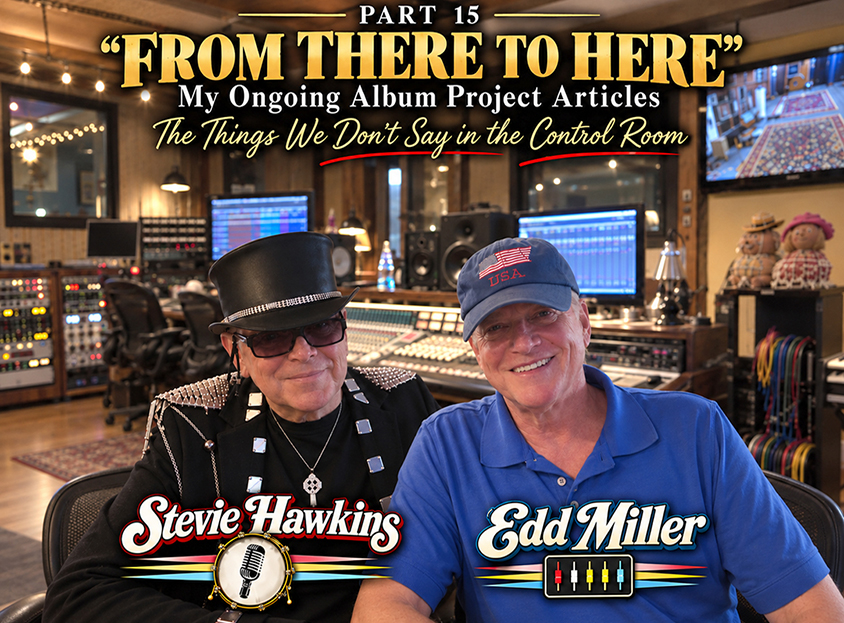
Part 16 of the ongoing Stevie Hawkins "From There To Here" album project...
There is something I've realized about making this album that I don't think I've talked about yet. As personal as the songs for my From There To Here album are, I've never really thought of them as being just about me.
That might sound a little strange. After all, I'm the one who lived these stories, wrote the songs, and sat down and tried to turn those experiences into words and music. But somewhere along the way, I realized I wasn't only asking myself, Is this my story? I was also asking, could this be somebody else's story, too?
That question matters to me, especially once the story songs came into play.
From My Story to Yours
When writing about things I've lived through, I'm not expecting the person listening to have lived through the exact same thing. That would be asking a lot. My life is my life, and your life is yours. But maybe the details are different and the feeling isn't. That's where I think a song can become something bigger than the person who wrote it, and that has been forefront in my mind throughout the lyric writing for this project.
There is another part of this that I've had to learn along the way, and it isn't always easy.
Sometimes it can be difficult to take something that happened in my life and try to shape it in a way that leaves room for somebody else's story. My memories come with very specific details, people, places, emotions, and circumstances. They belong to me. Trying to make those details relatable without watering down what actually happened can be a bit of a balancing act.
I don't want to force my story to fit someone else's life. And I don't want to change the truth of my experience just so somebody might recognize themselves in it.
What I've learned is that maybe I don't have to.
Maybe the connection doesn't come from making our stories the same. Maybe it comes from allowing the emotion to be recognizable even when the circumstances aren't.
Maybe someone hears a lyric and thinks about someone they lost, or a line about a relationship takes them back to a person who once meant everything to them. Something I've written about regret might bring back a decision they made twenty years ago, while a song about starting over could find somebody who is doing exactly that right now.
But it doesn't always have to be about the difficult parts of life. Maybe a positive lyric gives somebody a little encouragement when they need it, a motivational song helps them keep moving forward, or an upbeat, happy song simply puts a smile on their face and makes a good day a little better.
The story may not be theirs, but the feeling might be, and that's the part I'm interested in.
I might write about one particular person, but somebody else may hear it and think about an entirely different person. I might write about one kind of loss, while the listener connects it to another. I might be remembering a specific moment from thirty years ago, while someone hearing the song is thinking about something that happened last week.
That's where the challenge—and the magic—comes in.
I'm telling my story as honestly as I can while trying not to close the door on somebody else's.
And sometimes that's harder than it sounds.
I think that's one of the reasons there is so much contrast in the songs I've written for this album. Life isn't one emotion, and I don't think an album should have to be either. There are songs that look backward, songs that look forward, songs that deal with things that hurt, and songs that simply make me feel good. There are moments of reflection, encouragement, optimism, and moments when I just want to turn the volume up and enjoy the ride.
That's life as I know it, and I suspect it's life as most of us know it.
I Am the Listener First
I think of myself as an audience-first artist. After all is written and played, I want to know one thing:
Will it make the person listening feel something?
That philosophy doesn't stop when I walk onto a stage. I could be standing in front of 10,000 people, and if I can reach just one person on an emotional level or cause them to feel something they didn't expect to feel, then I've done my job.
It doesn't have to be all 10,000 people. I'm not keeping score.
If one person walks away from a performance feeling something because of a song I played or a lyric I sang, then that connection matters to me.
I think the same way when I'm writing. If I'm writing a lyric and I don't believe it, I don't care how good the rhyme is. If a melody is technically interesting but doesn't move somebody, what's the point? And if I hear something and immediately think, I would listen to that, then I know I'm getting somewhere.
That's been part of my process for a long time. Maybe I just never gave it a name.
There is a bit of a contradiction in all of this
The songs are deeply personal, but I'm not really writing them only for myself. I'm writing from my experience, but eventually I have to let the song go, and that's where something interesting happens.
The story starts with me, but it doesn't necessarily stay mine.
That's one of the strangest and best things about songwriting. You can spend hours alone trying to find the exact words for something that happened to you. You can stare at one line until you're convinced that changing one word will somehow alter the course of Western civilization.
It probably won't.
But you change it anyway.
You wrestle with the lyric. You move a word. You change a phrase. You sing it again. Sometimes you don't even know exactly why something isn't working—you just know it isn't. Eventually, after all that time spent making the song as honest and as right as you can make it, you have to do something that feels a little unnatural.
You have to let it go.
And once somebody else hears it, something changes.
They may hear the exact words I wrote, but they aren't necessarily hearing the exact song I wrote in my head. They bring their own memories, their own experiences, and their own meaning to it. Something that began as a very specific moment in my life can become connected to a completely different moment in somebody else's.
At that point, the song has left the building.
It's no longer completely mine, and I think that's one of the best things that can happen to a song.
I spent all that time trying to get the words right, only to eventually discover that I don't get to decide what those words mean to everyone who hears them.
And honestly, I'm okay with that.
Maybe that's the funny thing about writing for yourself.
You start alone with your own story, but if you've done it right, you don't get to keep the whole thing.
Making Room
To a great degree, that's what I've worked to accomplish writing for this album project. I'm not trying to tell somebody what their life means; I'm hopefully leaving enough room for them to find themselves somewhere inside the song.
I don't think a listener needs to know every detail behind a lyric for it to mean something. In fact, it's better if they don't. If I explain every word, every person, every place, every event, and every reason I wrote something, then I've pretty much taken the chair away from the listener.
I want to leave the chair there.
Let them sit down and bring their own memories, their own people, their own mistakes, their own good days, and their own bad ones. Maybe they hear a song and think about somebody they love. Maybe another song reminds them of a time when they needed a little encouragement. Maybe another one simply makes them smile.
They don't have to explain it to me, and they don't even have to know why.
If a song connects with something inside them, that's enough, and the lyric has done its job.
The Vulnerability of Letting It Go
There is also something a little vulnerable about putting personal experiences into a song and then sending it out into the world. Once I've written about something that happened to me, I've taken something that was private and turned it into something other people can hear.
I've thought about that quite a bit during this project.
There are stories on this album that are easy for me to talk about, there are stories I wondered if I should or should not talk about, there are stories that well up strong emotions, and there are others that even took a little more self-convincing before I was willing to put them into a lyric. Sometimes you have to decide whether you're comfortable letting people see that particular part of you. And with this album project, I have let it all hang out to a large degree.
There have been several songs where I've had to sing through them a few times before I could get a demo completed without having to stop and collect myself. That's probably as honest as I can be about what some of these songs mean to me.
But I've never believed that being personal means I have to explain everything.
A song can tell the truth without telling the whole story.
Maybe that's part of what makes songwriting work for me. I can take something that happened, find the emotion underneath it, and build a song around that emotion without necessarily handing someone the complete file folder of my life.
They get the song.
I get to keep a few of the classified documents.
And that's probably a healthy arrangement.
There's Room in These Songs
I think that's what I mean when I say I'm an audience-first artist. I'm not standing on one side of the music saying, Here is my life. Listen. I'm saying, Here's something I've lived. Here's what it felt like to me. Does any part of that feel familiar to you?
Maybe it does, maybe it doesn't. Maybe one song connects with you and another one doesn't. That's the way it should be.
We're all carrying different histories around with us, but songs have a funny way of finding the places where those histories overlap. Sometimes it's through a lyric, sometimes a melody, and sometimes it's nothing more than a groove that makes you feel good for three minutes and forty-two seconds.
I'm okay with all of it.
These songs started with my stories, but I don't want them to end there. If I've done this right, there should be a little room in each one for you to bring something of your own: your memories, your people, your mistakes, your good days, your bad ones, your hopes, your victories, and maybe even a story I've never heard.
That's the part of making music that still amazes me. I can spend months putting something together, believing I know exactly what I'm trying to say. Then somebody I've never met can hear the finished song and find something in it that I never consciously put there.
And they're not wrong.
That's their part of the song.
Because that's when a song becomes more than something I wrote. It becomes something we share.
There's room in these songs.
I hope you find your place in them.
- Stevie Hawkins
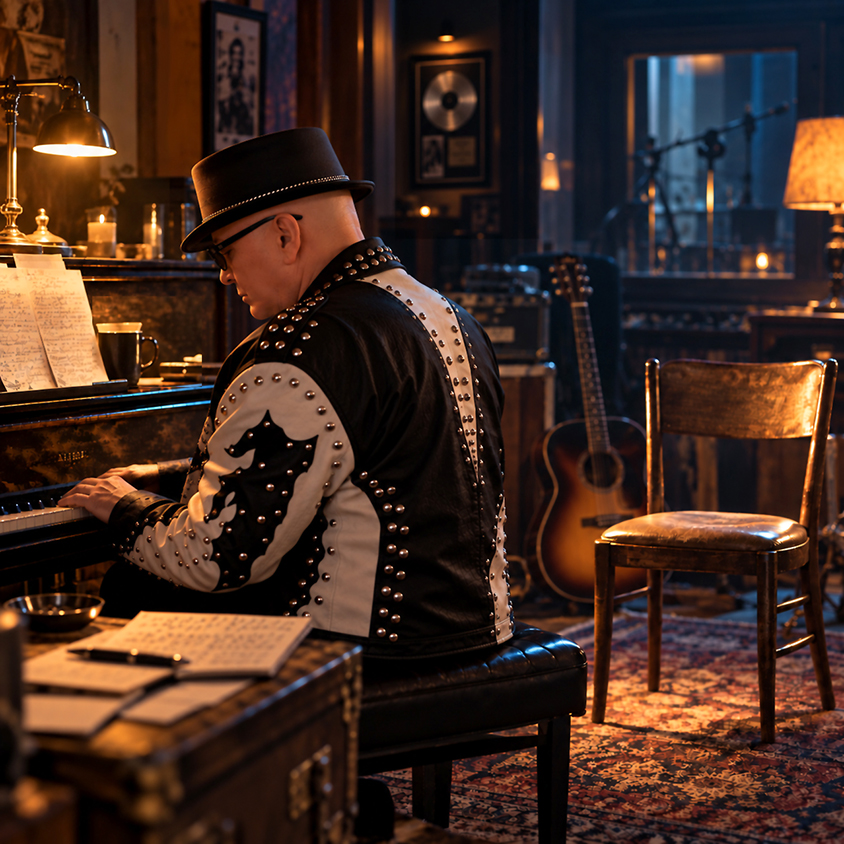
Part 17 of the ongoing Stevie Hawkins "From There To Here" album project...
When we recently left From There To Here, I was in the process of recording the demo guide vocals for the album.
And then I put the brakes on—not on the album or the project, just on the vocals.
I had another project that needed my attention: a website I was building for someone I've been working with since 2012.
His name is Gerald Murray.
Gerald owns Gerald Murray Home Center in Muscle Shoals, Alabama, a business that has been there since 1972. But that's only one side of Gerald's story. He also has a long history in the country music business as an artist manager and booking agent.
I first started working with Gerald in 2012, when he asked me to build a website for country artist Doug Stone, whom Gerald had just signed to a management deal. That project led to websites for Gerald Murray Music and later Gerald Murray Home Center, and Gerald and I have been working together ever since.
Fourteen years is a long time to work with somebody. Long enough that you stop being able to remember exactly when the professional relationship ended and the friendship started. Or maybe we just got comfortable enough with each other that neither one of us bothered to make that distinction.
And over that much time, you get to know a person pretty well.
One of the things I've always liked about Gerald is that he's a good man with a good sense of humor. After all these years, we've developed the kind of relationship where we can joke with each other, give each other a hard time, talk about work, talk about music, and then get right back to whatever we're doing.
Sometimes all in the same five-minute conversation!
But underneath all of that, there's something I value even more. Gerald does what he says he's going to do.
When I finish a job and send him an invoice, I can pretty much count on his check being in the mail the very morning he receives that invoice. No chasing him down. No wondering when I'll get paid. No carefully worded email three weeks later that begins with, "Just wanted to follow up..." when what I'm really thinking is, "Where's my money?"
He says he'll do something, and he does it.
After working with somebody for more than a decade, those things start to mean a lot. You learn who you can trust, who will stand behind his word, and who you can sit around and laugh with when the work is done.
That's Gerald.
It's a good friendship—or maybe, after all these years, the word "friendship" doesn't quite cover it anymore.
Maybe it's something more like a brothership.
I'm not sure that's actually a word, but after fourteen years, I think we've earned the right to make one up!
And then there's Gerald's music story.
He learned the artist-management ropes from J.R. Smith, who was Hank Williams Jr.'s manager. From there, Gerald went on to manage and work with artists including George Jones and his daughter, Georgette Jones; Vern Gosdin; Shenandoah; Doug Stone; Billy Dean; Mandy Barnett; Paulette Carlson of Hwy 101; Stella Parton; Darryl Worley; Bryan White; Lacy J. Dalton; Jamie O'Neal; Gary Morris; Cledus T. Judd; T. Graham Brown; and plenty of others.
Gerald has accumulated quite a few stories along the way. He even wrote a book about his time with Vern Gosdin, True Life Stories About "The Voice" Vern Gosdin, and at one point owned a recording studio in Nashville.
So here I am, building a website for a manufactured-home company in Muscle Shoals for a guy whose life has been so deeply connected to country music.
And while I was doing that, the microhpne was waiting on me to return to recording vocals.
This latest Home Center website build involved adding 58 manufactured-home selections and 6 additional content and contact pages to the retail site and bringing the business into the modern era of cross-platform usability. Phones, tablets, laptops, and desktops—everything has to work together now.
Which sounds simple enough until you actually have to make everything work together.
Like every website I've built over the years, this one was created from scratch. Every project is different, and every project presents its own set of challenges. Figuring out how to make all the pieces work together was part of what I enjoyed about doing it—or, at times, despised about doing it!
There's a point in almost every website project where you stop asking, "How do I make this work?" and start asking, "Why did I decide to do this to myself?" But eventually, you figure it out. And the funny thing is, the more I thought about it, the more I realized that building a website isn't all that different from creating music.
You start with an idea, and then you have to figure out how to turn that idea into something that actually works.
You move things around. You try something. You throw something out. You fix what isn't working. You keep going until the pieces finally start fitting together.
That's pretty much what happens when you're making a record, too. You start with an idea. Then you start moving things around. Then you decide something isn't working. Then you change it. Then you decide the original version was better. Then you wonder why you changed it in the first place Then, if you're lucky, you eventually remember what you were trying to accomplish.
That's pretty much the creative process.
And maybe that's where the connection to From There To Here really starts to make sense.
While I was taking Gerald's website from where it was to where it needed to be, my album was waiting for me to take it from where it was to where it needed to go. I didn't plan that parallel. It just happened.
And now the website is finished.
Which brings me back to the album.
There's another connection here that I didn't really think much about until now.
Gerald was the person who brought me into his music world fourteen years ago when he asked me to build that website for Doug Stone. Now, fourteen years later, after all the years we've worked together, Gerald may be the guy who helps me take my own music out into the world.
Once the album is completed, Gerald might be able to help me with booking my own shows—assuming I actually show up for them and stay on my best behavior. After all, he's already managed one "No Show."
So the same guy who first opened the door to his music world may eventually help me walk through another door in my own. Which is a pretty interesting way for all of this to come full circle.
Fourteen years ago, I thought I was building a website for Gerald. I had no idea I might eventually be building a path back into music for myself.
When you look at it that way, maybe the paths weren't as separate as I thought they were. Maybe this wasn't really a detour. Maybe it was just another part of the journey from there to here.
And after fourteen years, I suppose Gerald and I have become what Andy Griffith would have called, two birds in this world.
I know I qualify. Odd, unique, eccentric, and probably a little strange pretty much covers the bases.
Gerald's got his own qualifications. I'll let him tell you about those!
The website is done.
The album is still here.
And this week, I am back to recording those demo vocals.
- Stevie Hawkins
Part 18 of the ongoing Stevie Hawkins "From There To Here" album project...
Okay, folks... I have a confession to make. I don't really have time to write a proper From There To Here article this week.
Why?
Because I've got some vocals to do!
Or, as Ricky Ricardo might have put it:
“Lucy, you've got some 'splainin' to do!”
Except in my case...
“Lucy, I've got some vocals to do!”
The album is moving along, and at this time, there are things that are a little more important than sitting at the computer writing about the process.
Like actually singing the songs!
I've got demo vocals to finish, and I'd much rather spend my time this week putting my voice where my mouth is—literally.
So, I'll keep this one short. Right now, though... this doer ain’t ready to become a dider!
I've got some vocals to do!
Back to the microphone.... testing, ah-oh-ow, testing, cabbage, taters, biscuits, testing! Okay, reddy now!
- Stevie Hawkins
Part 19 of the ongoing Stevie Hawkins "From There To Here" album project...
For the past three years, I've been noting song concepts and possible titles with a new album project in mind. Although drums are my primary instrument, I've been writing songs on piano since 1976.
When the time came to begin writing for this album, the creative process took different paths. Sometimes, silence opened the door to the lyrics, allowing the words to emerge without music influencing the moment. Other times, a melody sparked the lyrics, or the words and melody developed together. The ideas came so quickly, one song after another, that I didn't want to interrupt the creative flow by stopping to record every melody taking shape in my head. Instead, I'd hum or sing a basic melody as I worked, trusting those initial musical ideas to guide me as the songs took shape. The demo music tracks came later. Of course, there's always the risk that a melody you can remember perfectly one minute will mysteriously disappear the next. Apparently, my brain doesn't come with a reliable save function.
Now I'm working through those tracks, developing the vocal melodies and figuring out how I want to sing the lyrics over the music. The initial melodic ideas gave me a starting point, but finding the right phrasing, timing, and emotional expression to bring the words to life requires a different kind of work.
Sometimes a melody comes together fairly quickly. Other times, finding the right melodic approach takes repeated listening and experimentation. I'll explore different phrasing and pay close attention to how the lyrics interact with the music, knowing that an approach that sounds promising at first may not ultimately capture the expression I'm after.
That's just part of developing a song.
I'm not simply looking for notes that work over a chord progression. I'm looking for the combination of melody, phrasing, timing, and emotion that captures the way I hear the song in my head and feel the message in my heart.
Finding the Sweet Spot
Developing a vocal melody that suits my singing style requires experimenting with different approaches until I find a melodic line that feels natural. I listen closely to the chords, the groove, and the movement of the arrangement, paying attention to how the lyrics fit the rhythm, which syllables need emphasis, and how one phrase leads into the next. I'm also thinking about the overall arc of the song. Where should the vocal pull back? Where does the melody need to build? Where should I let a lyric speak for itself rather than oversing the words?
Sometimes, the challenge is finding the right balance. One melodic approach might sound too predictable. Another might work musically but fail to communicate the emotion I'm after. A third might have the right notes but lack the phrasing needed to bring the lyrics to life.
No matter the style of music I'm singing, at my core, I'm a blues singer, and that translates into being a “feel singer.” The melody provides the foundation, but how I phrase the lyrics, shape the dynamics, and deliver the vocal can change from one performance to the next. I might stretch a word, lie back behind the beat, phrase against the groove, or add a little grit and texture when the song calls for those touches. The trick is knowing when you're expressing yourself and when you've simply lost your place!
For me, the art of singing comes down to knowing when to hold back and when to let go, when a lyric needs restraint and when the words call for raw emotion. I want the freedom to respond to the music in the moment without losing sight of the melody or the message behind the lyrics.
After decades as an artist, I've learned how important authenticity is to my creative work. Whether I'm developing vocal melodies, writing lyrics or shaping the music underneath them, every element has to feel honest and true to who I am as an artist.
I'm not a trend chaser or someone who shifts direction just because a particular style is popular. My goal is to create music that reflects my influences, instincts, and the stories I want to tell. I'm open to experimenting with melodies, exploring different phrasing, and trying new approaches, but no matter how much I evove creatively, the final performance must feel authentic to who I am as an artist and still sound like me.
I'm Not Chasing Perfection
My approach to recording vocals reflects the same instincts that guide me when developing a melody. I'm looking for a performance that captures the character of the song and allows me to express the lyrics naturally.
There's a difference between trying to make something perfect and trying to get the performance right.
I'm not chasing perfection. I want the performance to feel right.
For me, that means accepting small imperfections when they serve the performance rather than eliminating every little flaw or making every phrase technically flawless.
In my opinion, technical flawlessness isn't necessarily a reflection of a great performance. Musicians and professional vocalists may admire—and sometimes expect—pitch-perfect vocals, precision, and polished delivery. But non-musician music lovers don't necessarily listen with those same expectations. They want to feel something. They're not concerned with whether every note has been corrected with Auto-Tune or whether every detail has been polished to perfection. Sometimes, a performance can be slicked to death, losing the natural character, imperfections, and emotional nuances that make a vocal performance feel human. For me, the connection matters far more than technical perfection. At some point, you have to wonder whether you're listening to a singer or a software demonstration.
The careers of legendary artists such as Etta James, Janis Joplin, Jimi Hendrix, Willie Nelson, Billie Holiday, Louis Armstrong, Kurt Cobain of Nirvana, Howlin' Wolf (Chester Burdette), Bob Dylan, Loretta Lynn, Tony Bennett, Johnny Cash, Paul McCartney, and Neil Diamond illustrate this point. Rather than relying solely on technical precision, they have connected with listeners through expressive phrasing, distinctive vocal character, emotional honesty, and conversational storytelling. Their performances demonstrate that a voice doesn't have to be technically flawless to be compelling; sometimes, its imperfections are precisely what make it so human, relatable, and emotionally powerful. Research into these artists' vocal styles and careers supports these observations, which are based on facts rather than my personal opinion.
As a feel singer, I don't necessarily deliver every phrase identically from one take to another. The timing, emphasis, dynamics, and phrasing can shift naturally as I respond to the music. A note might be technically cleaner in one take, while another has more emotion or a little more soul or grit.
I'll choose the take that communicates the song most effectively, not the one that communicates the song “safely or too polished.”
When recording vocals, I work with one vocal track, singing the song from beginning to end and making adjustments along the way. That may mean singing a line again, replacing a line or reworking several lines until the performance feels right. There are also times when I capture the entire vocal in a single take.
I prefer to preserve the natural flow and continuity of a complete performance rather than assemble multiple takes recorded on different tracks at different times. Even when I return to a vocal on another day to change a line or phrase, I continue working with one vocal track, maintaining the same vocal approach throughout the performance. This allows the phrasing, tone, dynamics, and emotion to develop naturally, preserving the nuances that make a vocal feel alive without introducing the potential differences in emotional expression and tonal quality that can arise when combining separate takes.
When the Vocal Finally Comes Together
The moment I recognize the right performance, the search is over. The phrasing feels natural, the emotion comes through, and the vocal expresses the message I wanted to convey.
I don't necessarily think, That's perfect.
I think, That's the performance I've been searching for.
The difference matters. I'm not looking for a technically flawless vocal; I'm looking for a performance that carries heart and soul and tells the truth of the song.
Hearing the finished vocal express the lyrics the way I envisioned brings the whole creative process full circle.
That's the sweet spot. Not necessarily the perfect note, the perfect take, or the perfect performance on paper. Just the moment when everything feels right—and I know better than to mess with it.
- Stevie Hawkins